MAIN MENU

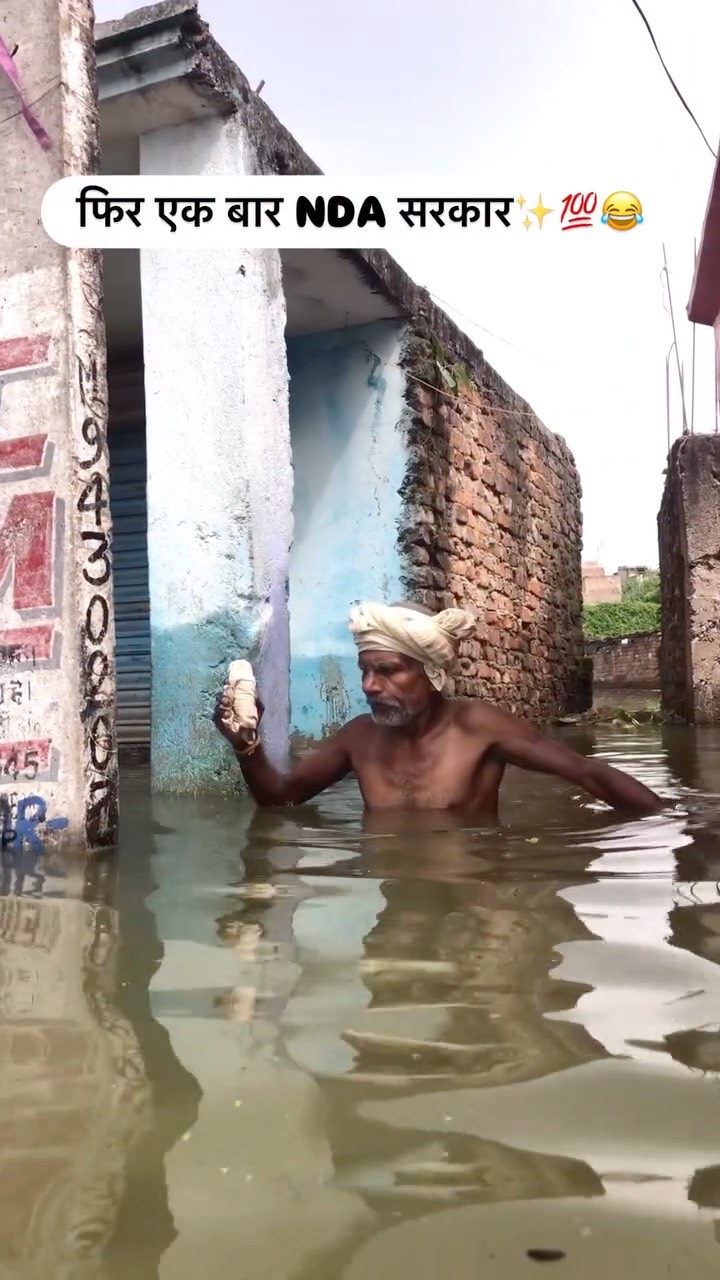
Viral Bihar flood reel mocks ‘phir ek baar NDA sarkar’ as 2026 floods expose persistent river-management risk
A 13 September Instagram reel shows a person wading through deep floodwater and mocks the slogan “phir ek baar NDA sarkar”, asking why Bihar has flooded again. Independent evidence confirms a severe September 2026 flood affecting millions and exposes Bihar’s persistent river-management and resilience challenge, but the reel does not establish that the NDA or any single policy caused the flooding.
An Instagram reel posted on 13 September 2026 shows a person wading through deep floodwater while carrying belongings overhead. Its on-screen text says “फिर एक बार NDA सरकार”, while the caption asks why Bihar has flooded again and urges the chief minister to pay attention. The post is political commentary: the images document severe flooding, but the caption’s implied attribution of the flood to the NDA government is an argument, not something the clip itself proves.
What the evidence establishes
The flooding is real and widespread. Bihar’s official flood-forecast system reported numerous rivers above danger level on 14 September, including the Ganga at several stations, the Kosi, Burhi Gandak, Bagmati and Punpun. Akashvani reported on 12 September that more than 2,000 villages across 14 districts remained affected, even as some river levels receded. Recent reporting put the affected population in the tens of lakhs.
The immediate hydrology is more complicated than the reel’s political punchline. Reporting on the September floods notes that Bihar had received below-normal monsoon rainfall overall before the flood peak, while high upstream flows, localized heavy rain and an already elevated Ganga produced a backwater effect that impeded tributary drainage. Bihar’s flood risk therefore cannot be reduced to the amount of rain falling inside the state or to a single government decision.
The larger issue: recurring exposure, not a one-event explanation
The reel’s stronger public-interest question is why a state with a long history of flood exposure remains so vulnerable. Bihar’s own disaster-management authority reviewed pre-monsoon preparedness in 15 flood-prone districts in June 2026, examining embankment safety, evacuation and rehabilitation plans, shelters and response resources. The Union government has also described flood management in the Ganga basin as requiring forecasting, evacuation planning, resilient communications, emergency logistics and India–Nepal coordination.
That evidence shows flood risk is recognised institutionally and managed through recurring preparedness and relief systems. It does not show that floods can simply be prevented by administrative attention. At the same time, the recurrence and scale of disruption make long-term river-basin management, drainage, sediment, floodplain use, embankment strategy and cross-border/upstream coordination legitimate governance questions rather than merely seasonal relief issues.
What cannot be concluded from the reel
The reel does not establish where or when its particular footage was recorded beyond the account’s Bihar framing, and no location metadata is attached to the Instagram post. It also does not prove that the 2026 flood was caused by negligence, by the NDA, or by any single policy. Government response was underway: NDRF and SDRF teams were deployed, relief materials were distributed, and the chief minister reviewed affected areas and relief operations.
The defensible conclusion is narrower but significant: the reel uses a genuine, severe flood emergency to challenge a governing alliance’s development message. Independent evidence confirms the emergency and Bihar’s persistent structural flood exposure, while responsibility for the specific flooding involves hydrology and river-basin conditions that the social-media caption alone cannot assign. The accountability question is therefore not whether a government can eliminate monsoon floods, but how effectively institutions reduce predictable risk, protect exposed communities and improve long-term resilience.
