MAIN MENU

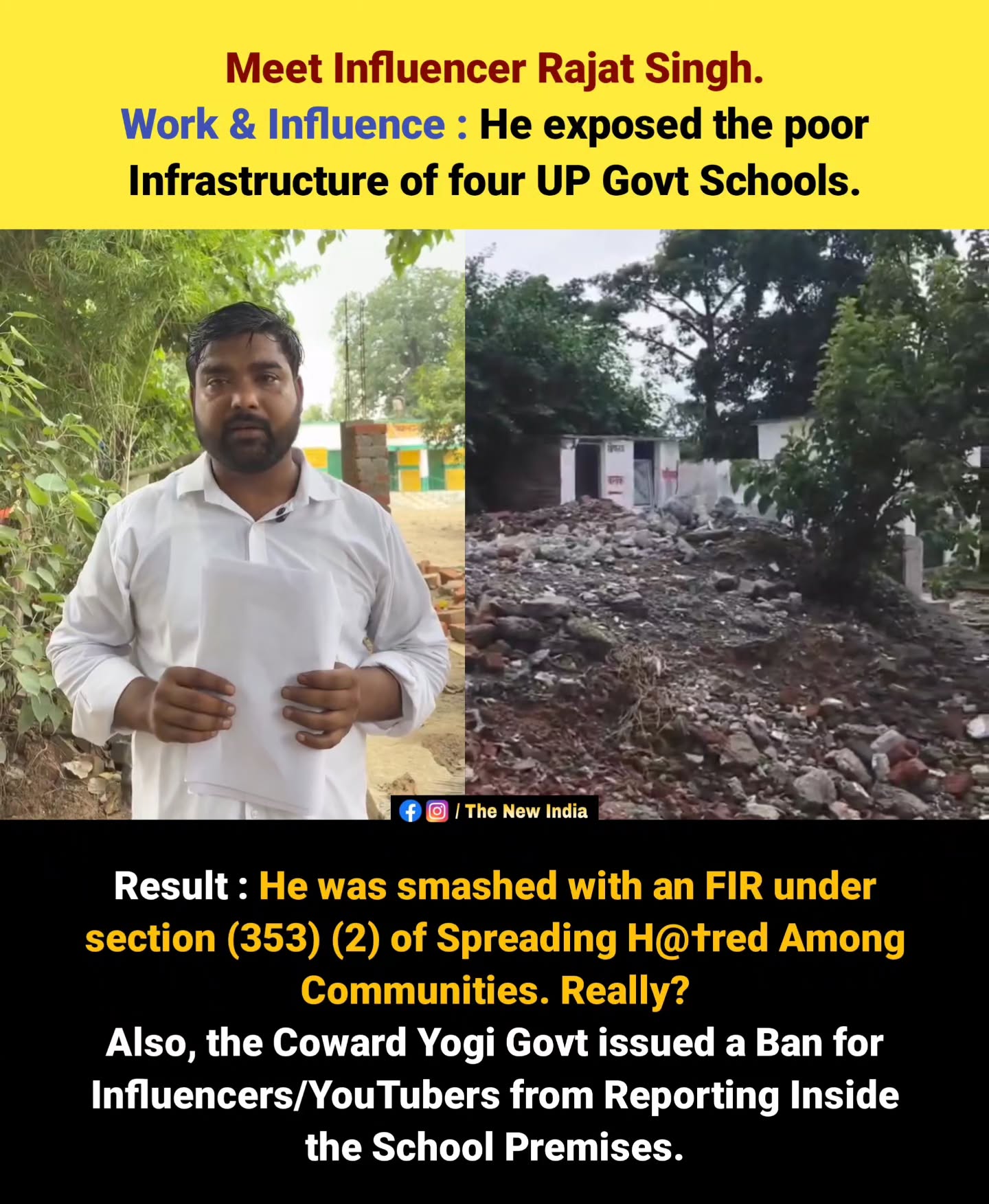
Rajat Singh’s Deoria school video led to an FIR as UP expanded restrictions on school filming
The New India said activist Rajat Singh was booked after exposing poor conditions in four UP government schools and that YouTubers were banned from reporting inside schools. The FIR over his Deoria school video is confirmed, and restrictions plus similar cases spread across several districts, but the FIR also cited BNS 329(4), the measures concerned unauthorised entry/filming rather than a proven statewide reporting ban, and IndiaFiles did not verify conditions at all four schools.
An Instagram graphic posted by The New India on 25 August 2026 says youth activist Rajat Singh exposed poor infrastructure at four Uttar Pradesh government schools, was then booked under Bharatiya Nyaya Sanhita (BNS) section 353(2), and that the state government barred influencers and YouTubers from reporting inside school premises.
What is established
The central event is real, but the graphic compresses important details. Deoria police registered an FIR against Singh on 22 August after a complaint by Block Education Officer Vinay Sheel Mishra over a video Singh made at the Damar Bishwa primary school in Gauribazar on 16 August. Contemporary reports say the FIR invoked BNS sections 329(4) and 353(2), not section 353(2) alone. The allegations concerned unauthorised entry and circulation of allegedly false or misleading information.
Singh’s video showed debris and what he described as a dilapidated school campus. The education department disputed that presentation. Officials said the debris came from an old, unused building that had been auctioned and demolished according to procedure, that removal was already underway, and that it was cleared after the video circulated. The complaint further alleged that Singh entered the closed school by climbing over a boundary wall. These are allegations in an FIR and departmental claims, not adjudicated findings. No arrest had been reported in the contemporaneous coverage reviewed by IndiaFiles.
The wider issue: access, scrutiny and criminal complaints
The Deoria case did not remain an isolated dispute over one video. Reporting in late August documented restrictions in several Uttar Pradesh districts requiring prior authorisation for outsiders, including YouTubers and social-media users, to enter government schools. On 22 August, Chief Minister Yogi Adityanath also directed officials to act against what the government described as false or misleading videos about schools and colleges, while instructing district officials to inspect facilities including classrooms, toilets and mid-day meals.
Subsequent reporting identified at least eight additional criminal cases in Uttar Pradesh involving journalists or political activists who filmed or publicised alleged deficiencies in government schools. That recurrence supports describing a broader enforcement and access pattern, while it does not establish that every video was accurate, every entry was authorised, or every FIR lacked an independent legal basis.
What the Instagram post gets right — and what it overstates
The post is substantially right that Singh faced an FIR after publicising conditions at a government school and that districts imposed restrictions on unauthorised filming or entry. It is incomplete in saying only section 353(2): reporting on the FIR also identifies section 329(4). Its wording that influencers and YouTubers were banned from “reporting inside the school premises” is broader than the evidence reviewed here. The documented measures concern entry or filming without prior permission in multiple districts; IndiaFiles did not establish a blanket prohibition on all reporting by all influencers or YouTubers across every Uttar Pradesh government school.
The graphic’s statement that Singh exposed four schools is also not what the Deoria FIR itself establishes. The criminal case described in the reporting concerns the Damar Bishwa primary school video. Singh has publicly referred to making multiple school videos, but IndiaFiles has not independently verified the condition of all four schools from primary records.
Why it matters
The public-interest question is larger than whether one social-media caption is perfectly worded. Government schools are public institutions responsible for children’s education, and credible evidence of infrastructure deficiencies warrants inspection and remedy. At the same time, schools have legitimate safeguarding, access and operational rules. The accountability issue is how authorities distinguish unauthorised entry or demonstrably false material from public-interest documentation and criticism, especially when criminal provisions are invoked alongside wider restrictions on filming.
The evidence reviewed here establishes a sequence: school-condition videos and protests drew public attention; authorities disputed some presentations; access restrictions spread across districts; and multiple FIRs followed, including Singh’s. It does not establish that the government’s motive was to silence criticism, as the Instagram caption asserts. That is an interpretation. What can be said is that the combination of access controls and criminal complaints raises a documented tension between school administration and independent public scrutiny, making the proportionality and factual basis of each enforcement action important to examine case by case.
