MAIN MENU

Instagram’s ‘BJP unicorn’ comparison uses real finance figures but obscures a wider concentration in political funding
An Instagram graphic accurately cites BJP’s rise from about ₹464 crore in assets and ₹324 crore in income in FY2012-13 to ₹12,171 crore and ₹6,769 crore respectively in FY2024-25, but its “unicorn” and corporate balance-sheet analogy is not like-for-like. The more consequential finding is that BJP accounted for about 85% of the combined income declared by six national parties in FY2024-25; the filings establish financial concentration, not illegality, motive or electoral causation.
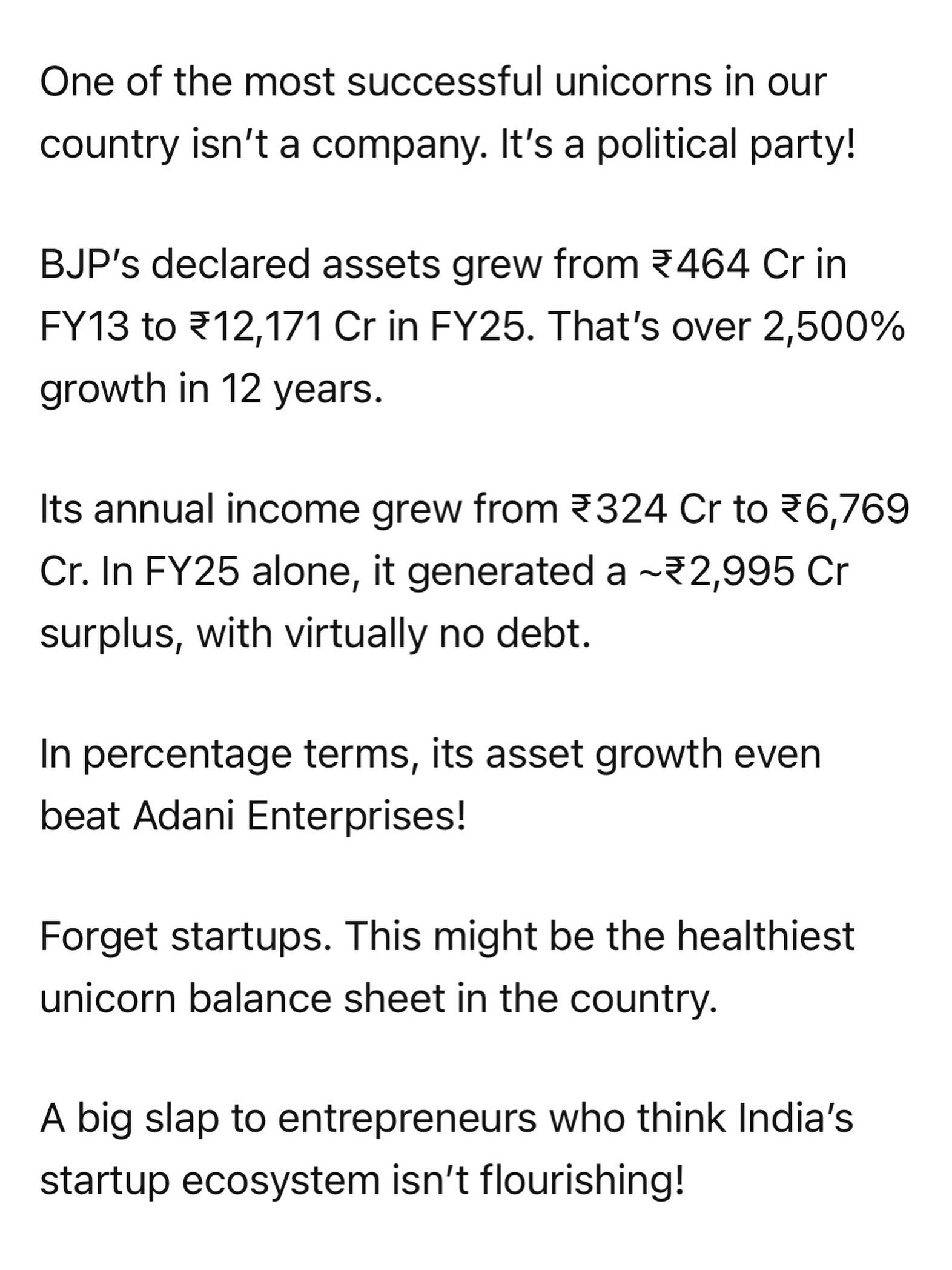
An Instagram graphic posted by fittrwithjc and coauthored with dimaginaxalpartyy_india calls the Bharatiya Janata Party (BJP) one of India’s most successful “unicorns”. It says the party’s declared assets rose from about ₹464 crore in FY2012-13 to ₹12,171 crore in FY2024-25, its annual income rose from ₹324 crore to ₹6,769 crore, and FY2024-25 produced a surplus of about ₹2,995 crore with “virtually no debt”. It then compares the percentage growth in BJP assets with Adani Enterprises and describes the party as having perhaps the “healthiest unicorn balance sheet” in the country.
What the filings support
The core BJP figures are substantially accurate. ADR/MyNeta’s compilation of the party’s filed accounts records total assets of ₹463.6362 crore and total income of ₹324.1626 crore in FY2012-13. For FY2024-25 it records assets of ₹12,171.1768 crore and income of ₹6,769.1498 crore. That is an increase of roughly 2,525% in declared assets and about 1,988% in annual income over the endpoints used in the graphic.
The FY2024-25 accounts also show ₹2,994.5673 crore as surplus carried to the general fund. Loans/borrowings were only ₹0.1543 crore, although the balance sheet also records ₹6.877 crore in current liabilities. So “virtually no debt” is a reasonable shorthand only if it refers narrowly to borrowings; it should not be read as literally having no liabilities.
ADR’s analysis of the six national parties’ FY2024-25 audit reports adds the more important comparator: BJP declared ₹6,769.15 crore of income, about 85.0% of the combined ₹7,960.10 crore income declared by those six national parties. BJP spent ₹3,774.58 crore during the year. Its own accounts show that ₹6,124.86 crore—about 90% of its income—came from voluntary contributions, while about ₹634.10 crore came from bank interest.
Where the “unicorn” analogy breaks down
A political party is not a startup or listed company. Its assets are not a corporate valuation, its annual surplus is not the same concept as profit attributable to shareholders, and political contributions are not business revenue earned by selling goods or services. The comparison therefore turns genuine accounting numbers into a rhetorical corporate analogy.
The claim that BJP’s asset growth “beat Adani Enterprises” is also not a meaningful measure of financial health without a consistently defined starting balance sheet, accounting perimeter and denominator. Adani Enterprises’ FY2024-25 consolidated accounts report total assets of about ₹1.98 lakh crore and substantial operating businesses, debt and capital investment. A percentage-growth contest between that company and a political party does not establish which has a “healthier” balance sheet.
The larger issue is political-finance concentration and transparency
The verified figures are significant not because they make BJP a corporate-style “unicorn”, but because they document how financially dominant one national party has become relative to its national competitors. That concentration matters in a democracy because money finances campaigning, organisation, publicity and political communication. The accounts alone, however, do not prove that financial dominance caused any particular electoral outcome, nor do they establish wrongdoing in how the money was raised.
The financing context also changed materially during the period selected by the graphic. Electoral bonds became a major source of political donations after their introduction in 2018. ADR found that BJP received ₹5,271.98 crore through electoral bonds between FY2016-17 and FY2021-22, more than half of its donations in the period examined. In February 2024, the Supreme Court struck down the Electoral Bond Scheme, holding that anonymising political contributions violated voters’ right to information; it also held the 2017 change permitting unlimited corporate political contributions arbitrary and unconstitutional. The Court subsequently directed disclosure of bond purchase and redemption data.
This does not mean the rise in BJP’s assets can simply be attributed to electoral bonds: the 12-year balance-sheet change reflects accumulated surpluses, contributions, interest and other accounting movements, and the graphic does not provide a causal decomposition. Electoral bonds are nevertheless part of the institutional history needed to understand the period rather than treating the party’s balance sheet as if it were a startup growth story.
Conclusion
Assessment: the headline financial numbers are substantially verified, but the corporate “unicorn” framing is misleading. BJP’s declared assets and income did rise dramatically between FY2012-13 and FY2024-25, and its borrowings at the end of FY2024-25 were minimal. The stronger public-interest finding is that BJP accounted for about 85% of the declared income of India’s six national parties in FY2024-25. That is evidence of a large financial asymmetry in national party politics; it is not, by itself, evidence of illegality, corruption, motive or electoral causation.
