MAIN MENU

Period 2024-25
Academic year 2024-25, including UDISE+ school education data.
A widely shared comparison places Kerala’s lowest-income district above Bihar’s richest. Official 2023–24 figures tell a more complicated story: Malappuram and Patna illustrate both India’s regional economic gap and why the year and price measure matter.
CATEGORIES : Economy
TAGS : District per capita GDP
TYPE : Analysis
EVIDENCE : Misleading context
UPDATED : 22 Oct 26 / 11:25 am
No comments on Malappuram and Patna: What District Income Figures Really Show About Kerala and Bihar
A satirical Instagram comparison points to the BJP’s nearly ₹10,000 crore in cash and equivalents in March 2025. Audited filings confirm a large BJP–Congress funding gap, but the post’s Congress balance and party-office counts are not established by the evidence examined. The larger issue is unequal financial capacity and voters’ right to know who funds…
GEOGRPAHY : India
UPDATED : 20 Oct 26 / 12:23 am
A reel contrasts a clear-looking mountain reach said to be near Yamunotri with thick froth on the Yamuna in Delhi. Government water tests confirm severe pollution in the capital, while research shows why foam is more complex than a single chemical or image.
EVIDENCE : Partially Verified
UPDATED : 19 Oct 26 / 10:29 am
Chetan Setia’s reel says Punjab jumped from 27th in 2020 to No. 1 in school education. The latest PGI does make Punjab the highest-scoring state and the national leader in its learning-outcomes domain, but official records show Punjab was already top by overall PGI score in 2019-20 and 9th among large states in NITI Aayog’s…
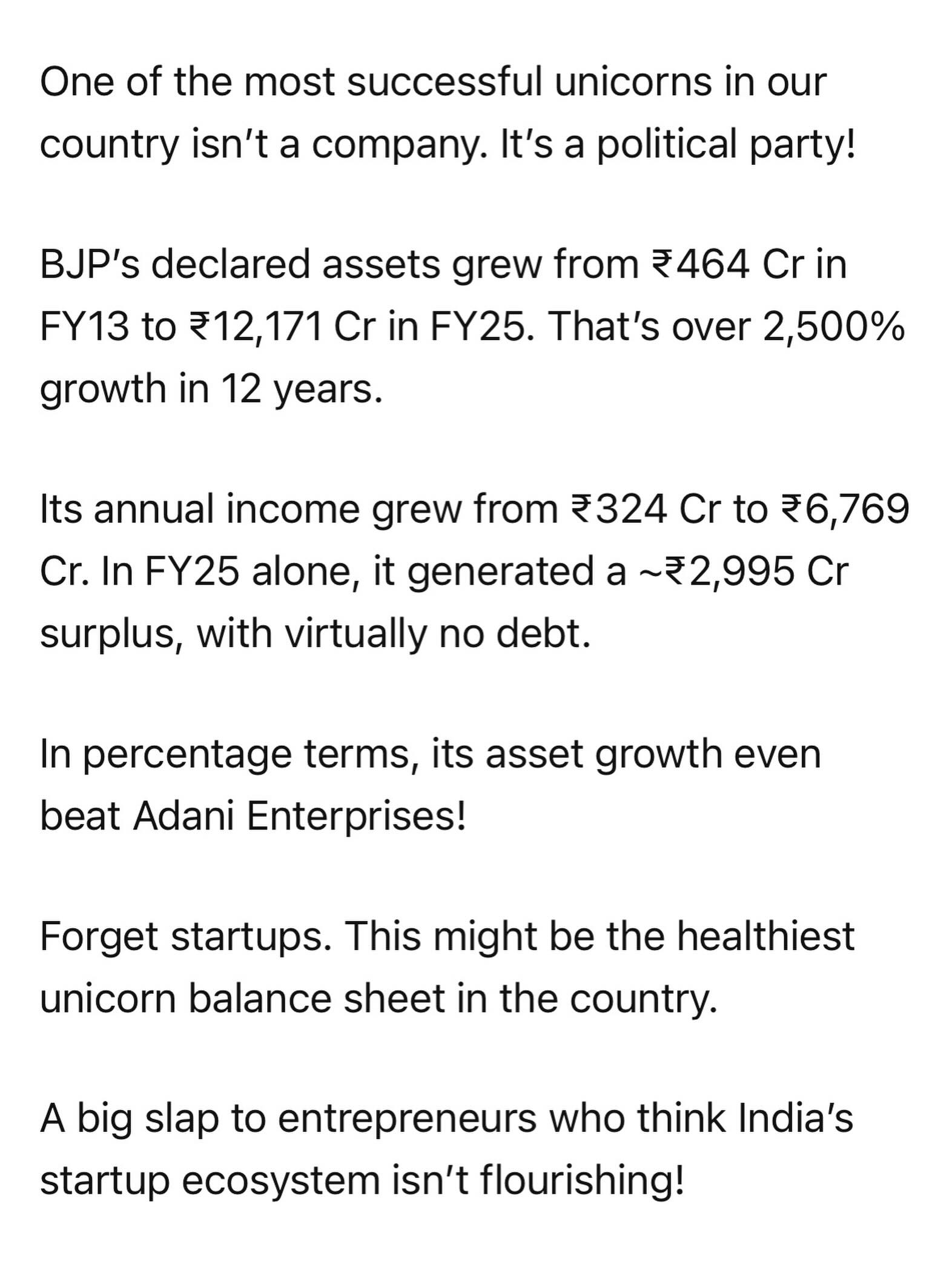
An Instagram graphic accurately cites BJP’s rise from about ₹464 crore in assets and ₹324 crore in income in FY2012-13 to ₹12,171 crore and ₹6,769 crore respectively in FY2024-25, but its “unicorn” and corporate balance-sheet analogy is not like-for-like. The more consequential finding is that BJP accounted for about 85% of the combined income declared…
Government-school counts fell, petrol later crossed ₹100, the rupee weakened and central liabilities rose during the period highlighted by the reel. But the viral scorecard mixes state-led school consolidation, an imprecise petrol baseline, subsidised versus non-subsidised LPG prices, exchange-rate movement and nominal debt as though they were one comparable measure of one leader’s performance; the…
TAGS : Central government debt, Fuel Prices, Government Schools, Indian Rupee, LPG Prices, Paper Leaks
ENTITIES : Narendra Modi
GEOGRPAHY : India
UPDATED : 13 Sep 26 / 11:33 am
Abhinay Sharma’s August 2026 reel is broadly right that India had roughly one lakh fewer government schools than a decade earlier, but the official record describes a net decline of about 94,000 linked to state-led consolidation and rationalisation—not proof that the Union government directly shut one lakh schools. The same evidence shows a wider shift…
TAGS : E20 Ethanol Petrol, Government Schools, Media Narrative, Paper Leaks, Political Accountability, Political Defections, School Consolidation
ENTITIES : Abhinay Sharma, All India Trinamool Congress, Bharatiya Janata Party, Himanta Biswa Sarma, Indian National Congress, Nitin Gadkari, Sonu Sharma, Suvendu Adhikari
GEOGRPAHY : India
UPDATED : 15 Sep 26 / 5:03 pm
A June 2026 reel reused an older “88% without internet” figure to describe current school conditions. UDISE+ 2024-25 shows internet facilities in 63.5% of all schools and 58.6% of government schools: a major decade-long expansion, but one that still leaves large government/private and interstate gaps. The statistic supports a continuing digital-divide concern, not the reel’s…