MAIN MENU

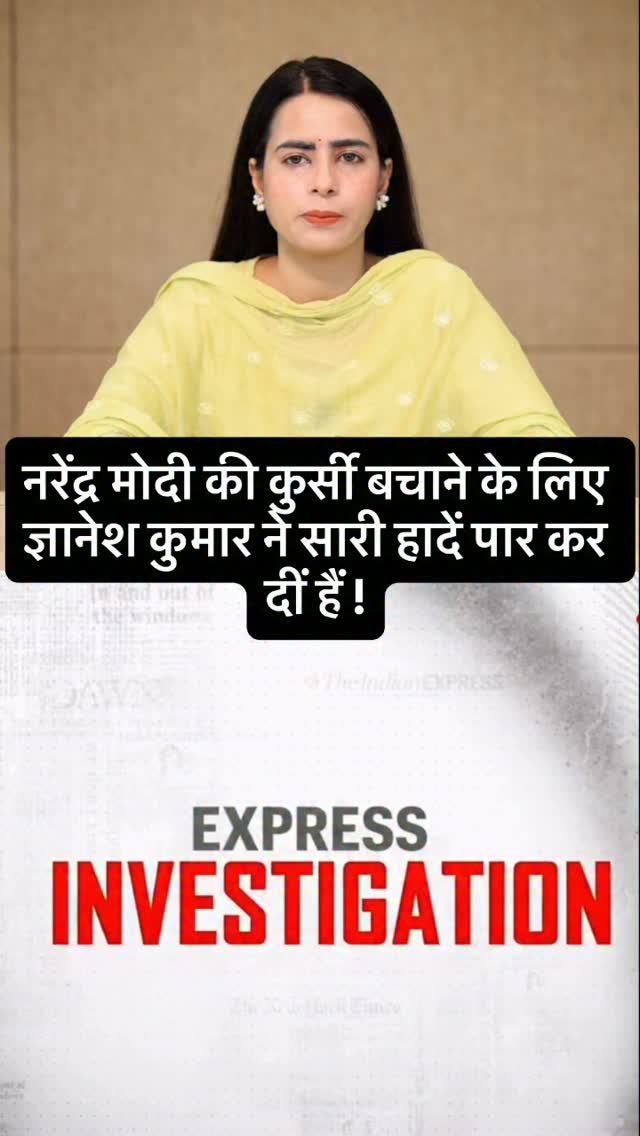
Vocal Naari’s ‘vote theft’ reel cites real Election Commission objections, but Modi-directed rigging is not established
Vocal Naari’s reel accurately cites The Indian Express finding that Election Commissioners Sukhbir Singh Sandhu and Vivek Joshi recorded at least 14 objections over ten months to how important poll-panel actions were handled. Those objections raise a documented question about Election Commission decision-making and voter-roll safeguards, but the evidence reviewed does not establish the reel’s further claim that Narendra Modi directed “vote theft”; EC officials have also said formal decisions were unanimous.
Listen to this article
Detecting language…
An Instagram reel by Vocal Naari (@vocal.naari), posted on 23 September 2026, uses a new Indian Express investigation to argue that Chief Election Commissioner Gyanesh Kumar has crossed institutional limits to protect Prime Minister Narendra Modi. The reel says two Election Commissioners recorded 14 objections in ten months over voter-roll decisions and then goes further, alleging that this proves “vote theft” directed by Modi and that the Election Commission is acting on the instructions of Modi and Amit Shah.
What the reporting establishes
The core factual premise is substantially supported. The Indian Express reported that Election Commissioners Sukhbir Singh Sandhu and Vivek Joshi put objections on record at least 14 times over ten months concerning decisions or communications they said were made without their knowledge or approval. The reported objections covered matters including changes to Form 6 for new voters, access and control over electoral-roll databases, appeals concerning voter inclusion and deletion, and communications issued in the Commission’s name.
The newspaper said it reviewed the written exchanges and contacted the Election Commission and the two Commissioners for comment. Its report described some of the objections as reaching the core of voter registration, deletion, restoration and the IT systems used to maintain electoral rolls.
The institutional issue is larger than the reel’s partisan conclusion
The public-interest significance is the question of how decisions are taken inside the three-member Election Commission, especially when they affect electoral-roll administration. Section 18 of the Chief Election Commissioner and Other Election Commissioners Act, 2023 says the Commission may regulate its procedure and allocation of business by unanimous decision; its business should, as far as possible, be transacted unanimously, and disagreements are to be decided by majority.
If two Commissioners were repeatedly recording that consequential actions were taken without their knowledge, that is relevant to institutional accountability and to safeguards around voter-roll administration. It does not, by itself, prove that any political party or political leader ordered those actions.
What the reel does not establish
The reel turns the reported internal objections into a much stronger causal allegation: that Gyanesh Kumar was placed in office to conduct “vote theft” for Narendra Modi, and that the Election Commission is operating under the direction of Modi and Amit Shah. The sources reviewed for this record do not establish that chain of command, motive or electoral effect.
The Indian Express investigation documents internal objections and questions about procedure and voter-roll controls; it does not present proof that Prime Minister Modi ordered those disputed steps. Nor does the existence of internal objections, on its own, establish that votes were stolen or that an election result was changed.
A material counter-position
After the investigation was published, Election Commission officials told Hindustan Times that all decisions of the Commission, including the Special Intensive Revision exercise, had the approval of all three Commissioners. That is a material counter-position to the report’s portrayal of internal disquiet. The public reporting available here does not resolve the tension between that statement and the written objections described by The Indian Express.
Assessment and significance
The reel is anchored in a real and consequential piece of reporting: two of the three Election Commissioners were reported to have put repeated objections on record about how important electoral-roll and Commission decisions were handled. The evidence supports scrutiny of the Election Commission’s internal decision-making, statutory process and digital control over voter rolls.
But the reel’s larger accusation — that these objections prove Modi-directed “vote theft” or establish partisan control of the Election Commission — goes beyond the evidence reviewed. The documented issue is an institutional one: whether the Commission’s internal procedures and safeguards were followed, what authority was exercised by whom, and how those questions affected voter-roll administration. The available evidence does not establish a political command structure, private motive or changed election outcome.
Sources
- Vocal Naari Instagram reel, 23 September 2026.
- The Indian Express — 14 times in 10 months, two Election Commissioners objected on record to poll panel steps, 23 September 2026.
- The Indian Express — What Election Commission rift reveals: Cloud over its conduct, 23 September 2026.
- Hindustan Times — EC officials say SIR and other decisions were unanimous, 23 September 2026.
- Chief Election Commissioner and Other Election Commissioners (Appointment, Conditions of Service and Term of Office) Act, 2023, Section 18.
