MAIN MENU

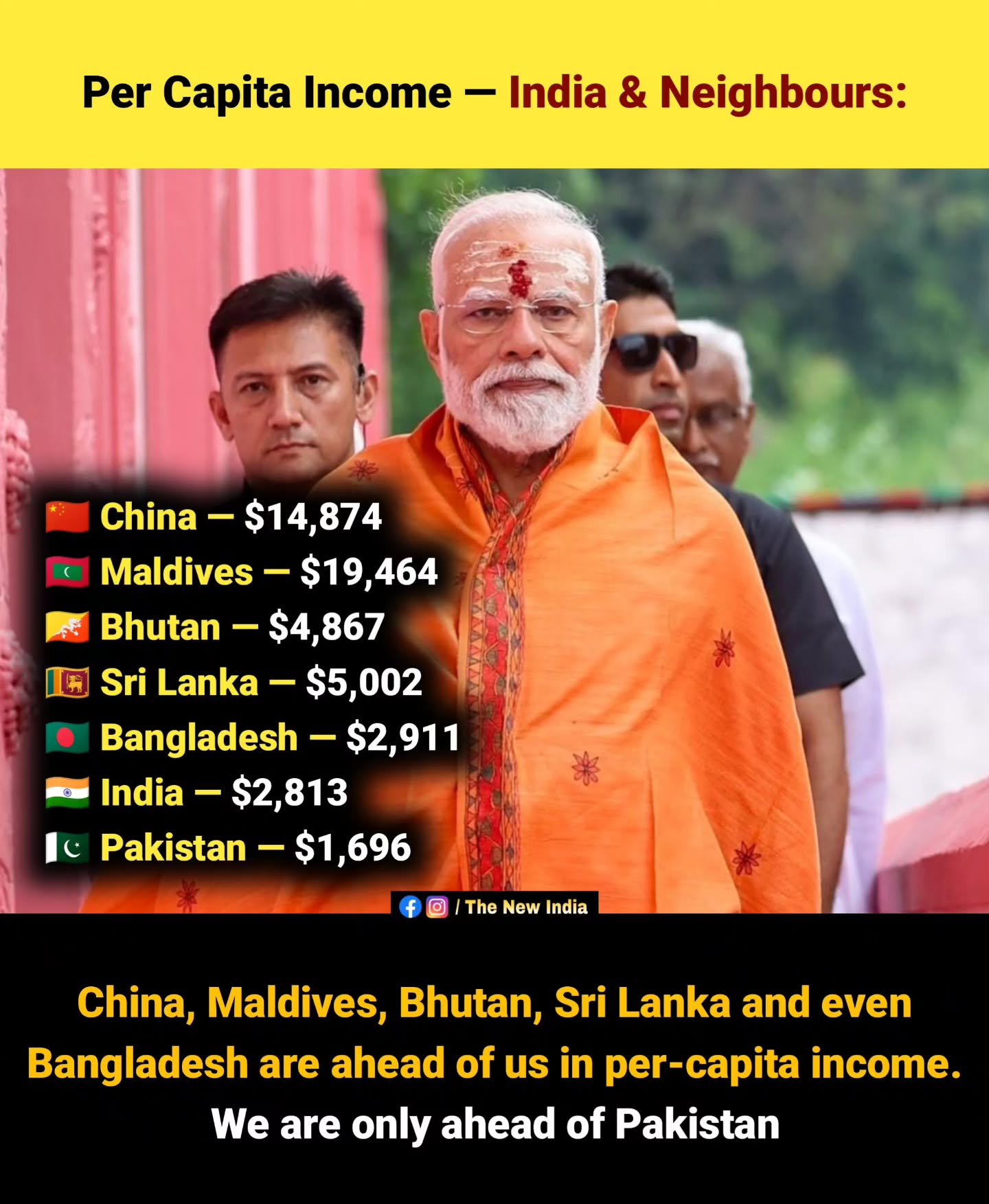
India’s nominal GDP per person remains low among several neighbours, but the viral chart mixes projections with actual data
The graphic’s broad regional comparison is directionally supported, but its figures are nominal GDP per capita—not personal income—and mix 2026 IMF projections with latest available data for Sri Lanka and Pakistan. The more important finding is that India’s per-person output remains low despite its large aggregate economy; the projected Bangladesh crossover is narrow and not yet an observed 2026 outcome.
An Instagram graphic posted by The New India on 9 September 2026 says China, Maldives, Bhutan, Sri Lanka and Bangladesh are ahead of India in “per-capita income”, while India is ahead only of Pakistan. The comparison points to a real economic gap, but its presentation needs two important qualifications: the figures are nominal GDP per capita, not household or personal income, and the list mixes 2026 IMF projections with latest available values for countries where a comparable 2026 IMF figure is not shown.
What the numbers represent
The values shown for China ($14,874), Maldives ($19,464), Bhutan ($4,867), Bangladesh ($2,911) and India ($2,813) match 2026 nominal GDP-per-capita projections based on the IMF’s April 2026 World Economic Outlook. IMF-based tables describe this indicator as GDP per person at current prices in US dollars. For Sri Lanka, the displayed $5,002 is a 2025 World Bank value; Pakistan’s $1,696 is a 2025 IMF value. In other words, the graphic is not a clean same-year table of observed “income”.
The distinction matters because nominal GDP per capita is an economy-wide average: total economic output divided by population and converted at market exchange rates. It is not the amount an average person earns or takes home. Exchange-rate movements can also change nominal US-dollar comparisons even when domestic real output follows a different path.
Is the ranking itself wrong?
For the 2026 projections used by the graphic, the ordering is broadly supported: India’s projected $2,813 is below Bangladesh’s $2,911 and well below Bhutan, Sri Lanka, China and Maldives, while remaining above Pakistan’s latest $1,696 figure. But this is a forecast snapshot, not an established 2026 outcome. The year choice also matters. IMF 2025 estimates put India at about $2,675 and Bangladesh at about $2,636, leaving India narrowly ahead that year. The graphic therefore turns a small projected crossover into an unqualified statement about current “income”.
The larger issue is India’s low per-person output, not Pakistan alone
The more durable finding is not the meme-like India–Pakistan contrast. India is a very large and fast-growing economy, yet its economic output per person remains modest. World Bank data put India’s nominal GDP per capita at about $2,695 in 2024 and $2,702.5 in 2025. That level is far below several neighbouring economies, although country size, exchange rates, sector structure and price levels make direct welfare comparisons more complicated.
For living-standard comparisons, purchasing-power-parity measures can be more informative because they adjust for differences in local price levels. Real GDP per capita is also better suited to tracking growth over time because it removes inflation effects. Neither measure, however, captures distribution: GDP per capita can rise while gains are concentrated unevenly across households.
What can and cannot be concluded
The graphic is best read as a partly valid warning about India’s relatively low nominal GDP per person, not as a literal table of average incomes. Its strongest substantive point survives the technical problems: India’s large aggregate GDP does not translate into similarly high output per resident, and comparisons only with Pakistan can obscure the scale of the gap with other regional economies. But the graphic does not establish why those gaps exist, who is responsible for them, or how individual household incomes compare across these countries.
Sources: IMF World Economic Outlook, April 2026; World Bank World Development Indicators; the original Instagram post.
