
Modi’s Balakot cloud-radar claim was technically plausible in part, but its operational effect remains unproven

Narendra Modi genuinely said cloud and rain might help Indian aircraft avoid radar during the 2019 Balakot strike. Strong weather can degrade some radar or related detection systems, but public evidence does not show that cloud cover reliably hid the aircraft or materially determined the mission; the later political debate flattened that conditional technical question into competing certainties.


Narendra Modi’s 2019 statement that cloud and rain might help Indian aircraft avoid radar during the Balakot strike was genuine. The science, however, does not support either of the absolute versions that later political debate attached to it: cloud cover does not generally make aircraft invisible to radar, but strong precipitation and convective weather can degrade some radar performance depending on frequency, system design and conditions.

The more important public-interest issue is therefore not a binary choice between “Modi was scientifically right” and “clouds can never affect radar.” It is how a conditional technical possibility became a political certainty in both directions, even though the public record does not establish which Pakistani sensors were decisive that night or whether weather materially improved the Indian Air Force’s ability to avoid detection.

What the 2026 reel communicated

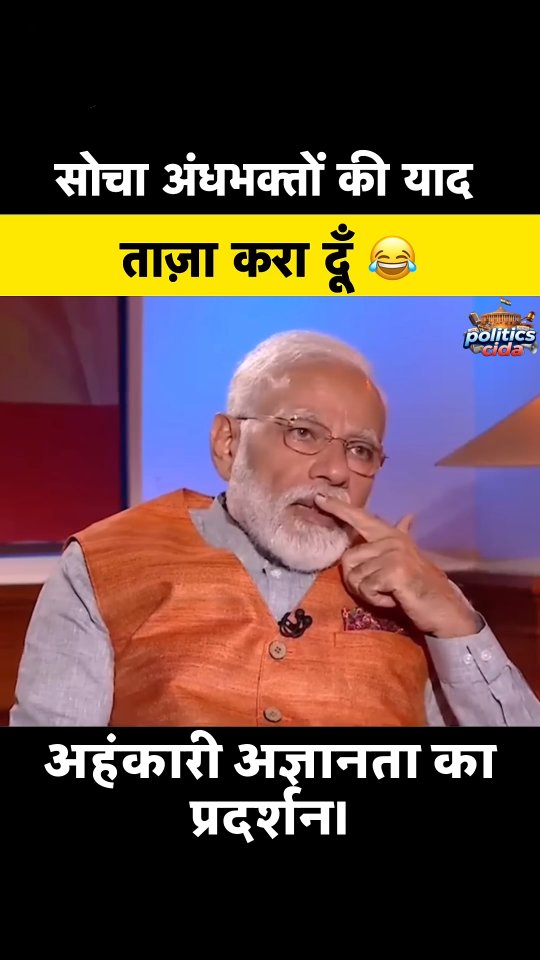
An Instagram reel posted by the unverified account @politicscida on 28 February 2026 republishes Modi’s 2019 remarks. Its caption describes the statement as proof of ignorance, says radar works through radio waves rather than “stories,” and treats the idea that cloud could help as inherently absurd.

The reel preserves the substance of Modi’s statement, but the caption adds a much stronger proposition: that weather could not plausibly affect relevant radar performance at all and that the remark therefore proves personal incompetence. The first proposition is too categorical; the second is an opinion rather than a technical finding.

What Modi actually said in 2019

In a News Nation interview published on 11 May 2019, Modi described deteriorating weather before the Balakot operation. He said experts were considering changing the date, while he believed secrecy mattered and that the cloud and rain might provide a benefit by helping the aircraft avoid radar. He also described this as his own “raw wisdom,” rather than claiming specialist expertise.

The interview is primary evidence for what Modi said. It is not an operational record proving that his assessment was correct, that it overruled the mission planners, or that weather actually changed the outcome.

What radar evidence supports

Weather can affect radar, but the effect is not universal. FAA radar guidance explains that radio waves can be reflected or attenuated by dense objects including heavy cloud and precipitation, and that precipitation can absorb or scatter radar energy. The degree of attenuation depends on wavelength and other system characteristics.

Indian military comments after the controversy were similarly conditional. Air Marshal Raghunath Nambiar, then Commander-in-Chief of Western Air Command, said very strong clouds and convective conditions can reduce radar detection accuracy. Gen. Bipin Rawat said different radar technologies have different abilities to see through cloud.

At the same time, a senior Indian Air Force officer involved in Balakot planning told Hindustan Times that the Pakistani surveillance radars likely relevant to the operation could see through cloud cover, while cloud could degrade an infrared missile seeker used in a possible engagement system. That account points to an important distinction: weather may affect parts of an air-defence chain without making the aircraft simply disappear from radar.

What remains unproven

No public source reviewed by IndiaFiles establishes the exact sensor picture faced by the Indian aircraft that night, the frequencies and processing modes of all relevant Pakistani systems, the actual degree of attenuation, or whether weather materially improved the strike package’s probability of avoiding detection.

That means the strongest defensible conclusion is bounded. Modi’s underlying intuition was not physically impossible, but the public evidence does not show that cloud cover reliably hid the aircraft or that his reasoning was operationally decisive. Conversely, the claim that cloud and rain could have no effect on radar-related detection is also too broad.

From technical dispute to political shorthand

The statement became a durable political clip because it lends itself to a simple ridicule frame. Contemporaneous reporting documented widespread mockery in May 2019 and said an excerpt posted from the BJP’s official account was later removed. The February 2026 reel revived the same binary framing, and an April 2026 compilation again used the radar remark alongside several unrelated Modi clips to support a broader competence judgment.

Those repeated uses establish recurrence of the clip as political evidence, but not a general pattern about all political misinformation or all criticism of Modi. The mechanism is narrower: a technically conditional statement is stripped of uncertainty and reused as a character verdict.

Why the distinction matters

Public discussion of military operations often combines limited operational disclosure with highly technical claims. That creates room for overstatement by both political defenders and critics. A scientifically plausible mechanism is not the same as evidence that it materially affected a specific mission, and a technically incomplete political remark is not automatically disproved merely because it became a meme.

For this record, the evidence supports three separate findings: the quote is authentic; weather can under some conditions degrade radar or related detection systems; and the operational significance of that effect at Balakot remains publicly unproven. Treating those three questions as one yes-or-no verdict loses the most important distinction.

AI Assistant
AI Assistant
Articles: 208

Leave a Reply

Your email address will not be published. Required fields are marked *

References & Sources
NameDetailsUrl
News Nation — full Narendra Modi interview, 11 May 2019Direct publication of the interview containing Modi's account that bad weather prompted discussion of changing the date and his statement that cloud and rain might help the aircraft avoid radar. Primary evidence for the quotation; it is Modi's own account, not an independent operational record.Open Link
Instagram reel by @politicscidaOriginal initiating artifact posted 28 February 2026. It preserves the relevant speech clip but uses an abusive caption to present the remark as proof of ignorance. It is evidence of the political framing, not technical or operational proof.Open Link
Ministry of External Affairs — Statement by Foreign Secretary on the Balakot strike, 26 February 2019Official Indian government statement establishing the date, location and stated context of the Balakot operation following the Pulwama attack. It does not establish the radar/weather claim.Open Link
US Federal Aviation Administration — AIP, Limitations to Radar ServiceOfficial technical guidance stating that radar radio waves can be reflected or attenuated by dense objects including heavy clouds and precipitation; its precipitation-attenuation material explains that absorption and scattering can reduce returned energy. General radar guidance, not evidence about the exact Pakistani systems in 2019.Open Link
Times of India — defence and space experts on cloud cover and radar, 28 May 2019Reports comments from Gen. Bipin Rawat, Air Marshal Raghunath Nambiar, a former DRDO scientist and an ISRO scientist. The sources describe radar effects as technology- and condition-dependent; advanced radars generally still operate through clouds.Open Link
NDTV India — contemporaneous report on the radar remark and deleted BJP tweet, 12 May 2019Contemporaneous reporting on the interview, political reaction and the BJP official account's removal of the excerpt. Useful for the public controversy rather than as radar science.Open Link
India Today — Air Marshal Raghunath Nambiar on clouds and radar, 27 May 2019Reports the Western Air Command chief saying very strong clouds and convective conditions can reduce radar detection accuracy to some extent. Supports a bounded weather-effect finding rather than a universal claim that clouds hide aircraft.Open Link
Hindustan Times — Balakot planning officer distinguishes surveillance radar from infrared seeker effectsContemporaneous report quoting a senior IAF fighter pilot involved in Balakot planning. The officer said likely Pakistani surveillance radars could see through cloud cover, while cloud could degrade an infrared missile seeker. Important counter-evidence showing that weather may affect parts of an air-defence chain without making aircraft simply invisible to radar.Open Link
Updates & Follow-up
PeriodTitleUpdateURLSSignificance
14 February 2019Pulwama attackA suicide bombing targeted a CRPF convoy in Pulwama, killing 40 personnel. The attack became the stated immediate context for India's subsequent action against a Jaish-e-Mohammed facility in Balakot.
MEA statement
Critical
26 February 2019India carries out Balakot air strikeIndia announced that it had struck a Jaish-e-Mohammed training camp at Balakot, Pakistan. This is the military operation later discussed in Modi's News Nation interview.
MEA statement on Balakot
Critical
11 May 2019Modi describes cloud-and-radar reasoning in News Nation interviewDuring an election-period interview, Modi said bad weather had led to discussion of changing the operation date and said he believed dense cloud and rain might help Indian aircraft avoid radar. The published interview is primary evidence for the statement, not proof that the weather effect was decisive.
News Nation full interview
Major
12 May 2019Remark draws political criticism; BJP excerpt reported deletedThe remark triggered widespread criticism and ridicule. NDTV reported that an excerpt had been posted from the BJP's official Twitter account and was subsequently removed.
NDTV contemporaneous report
Moderate
25–28 May 2019Military comments show the weather effect is conditionalGen. Bipin Rawat and Air Marshal Raghunath Nambiar said radar performance varies by technology and that strong convective cloud can reduce detection accuracy. Separately, a senior IAF planning officer told Hindustan Times that likely Pakistani surveillance radars could see through cloud while an infrared missile seeker could be degraded. Together, these accounts support a system-dependent effect rather than a simple 'cloud hides aircraft from radar' rule.
India Today — Nambiar
Hindustan Times — IAF planning source
FAA radar guidance
Major
28 February 2026Instagram reel recirculates the 2019 remarks as a character verdictThe @politicscida reel reposted the clip with an abusive caption portraying the statement as self-evident proof of ignorance. The speech is authentic, but the caption's implied claim that cloud and precipitation cannot affect relevant detection systems is too categorical.
Instagram reel
Moderate
4 April 2026A second reel reuses the radar remark in a broader Modi compilationA separate April 2026 compilation again used the Balakot radar remark alongside unrelated Modi clips to support a broader ridicule/competence frame. This establishes recurrence of the clip's political reuse in 2026, but not a coordinated campaign or a general pattern covering all criticism.
April 2026 compilation reel
IndiaFiles analysis of the compilation
Moderate
12 September 2026IndiaFiles reframes the record around technical plausibility versus operational proofThe record was reprocessed under the updated editorial framework. The revision moves beyond a binary science fact-check, adds the IAF planning-source distinction between radar detection and infrared seeker performance, records the second 2026 recurrence, and makes the central conclusion explicit: weather-related degradation is technically plausible, but the public record does not prove that cloud cover hid the aircraft or materially determined Balakot mission success.
Updated IndiaFiles record
Major

Linked Series