MAIN MENU

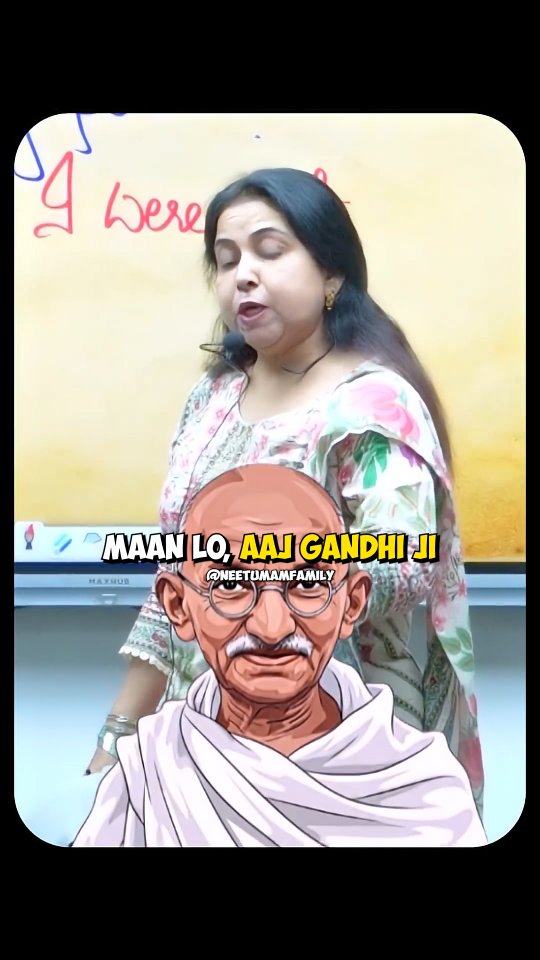
Neetu Singh’s ‘WhatsApp University’ rebuke invokes Gandhi’s resistance to British rule — but simplifies colonial rights
In a July 2026 reel, educator Neetu Singh tells students that Gandhi’s resistance to British rule required courage and rebukes “WhatsApp University” learning. Archival records support the reality of colonial repression and Gandhi’s arrests, but her statement that people then had “no rights” is an over-broad contrast with today’s constitutional fundamental-rights framework; the clip also does not establish what misinformation the students had consumed.
In an Instagram reel posted on 28 July 2026, educator Neetu Singh responds to students who appear to laugh at the idea of Mahatma Gandhi confronting authority. She tells them that standing even before a police baton can be frightening, contrasts that with Gandhi standing against British rule, and says that understanding Gandhi requires reading him rather than learning from “WhatsApp University”. She ends by calling such students “andhbhakt”.
The central historical point behind the rebuke is well supported: Gandhi led mass campaigns against British colonial rule and repeatedly faced repression, arrest and detention. Government and archival records document the Non-Cooperation and Civil Disobedience movements, Gandhi’s arrest in 1930, later detention, and British measures intended to contain these campaigns.
One part of the classroom formulation, however, is too absolute. Singh says that today people can invoke the Constitution and rights, whereas “us samay koi adhikar nahin tha” — there were no rights then. Colonial India did not have the post-1950 Constitution or its present framework of fundamental rights, and repressive colonial laws sharply curtailed civil liberties. But saying there were literally no rights at all collapses a more complicated legal history into rhetoric. The defensible contrast is between today’s constitutionally guaranteed fundamental-rights framework and a colonial state that could restrict political activity through laws, executive powers, arrests and detention.
The reel therefore works better as an argument about historical memory than as a precise statement of colonial constitutional law. Its broader public-interest issue is how popular historical understanding is formed in an environment where simplified or misleading claims circulate through social media and messaging networks. Singh’s “WhatsApp University” label is rhetorical; this reel by itself does not establish what particular misinformation the students had consumed or prove that WhatsApp caused their view.
The archival record nevertheless supports the substance of her comparison about the risks of anti-colonial political action. British Library India Office records describe government policy toward Gandhi and the Civil Disobedience Movement, including imprisonment and measures to contain it. UK parliamentary records document Gandhi’s May 1930 arrest under the Bombay State Prisoners’ Regulation. Government of India historical material records large-scale arrests during the Non-Cooperation Movement. Those sources establish repression and personal risk without requiring the stronger claim that colonial subjects possessed no legal rights whatsoever.
Why it matters
The exchange illustrates a recurring problem in public history: correcting misinformation can itself rely on compressed historical language. The useful distinction is not between perfect textbook knowledge and “WhatsApp” ignorance, but between claims that can be traced to evidence and claims that cannot. Gandhi’s confrontation with colonial authority is extensively documented; the students’ alleged information source is not established by the clip, and the claim that colonial India had “no rights” should be read as rhetorical shorthand rather than a literal legal finding.
Evidence limits
The available reel is about 41 seconds and does not show the discussion that preceded Singh’s remarks. IndiaFiles can verify what she says in the clip and independently check the historical propositions above, but cannot infer what the students previously said, what sources shaped their views, or Singh’s intent beyond the recorded remarks.
