MAIN MENU

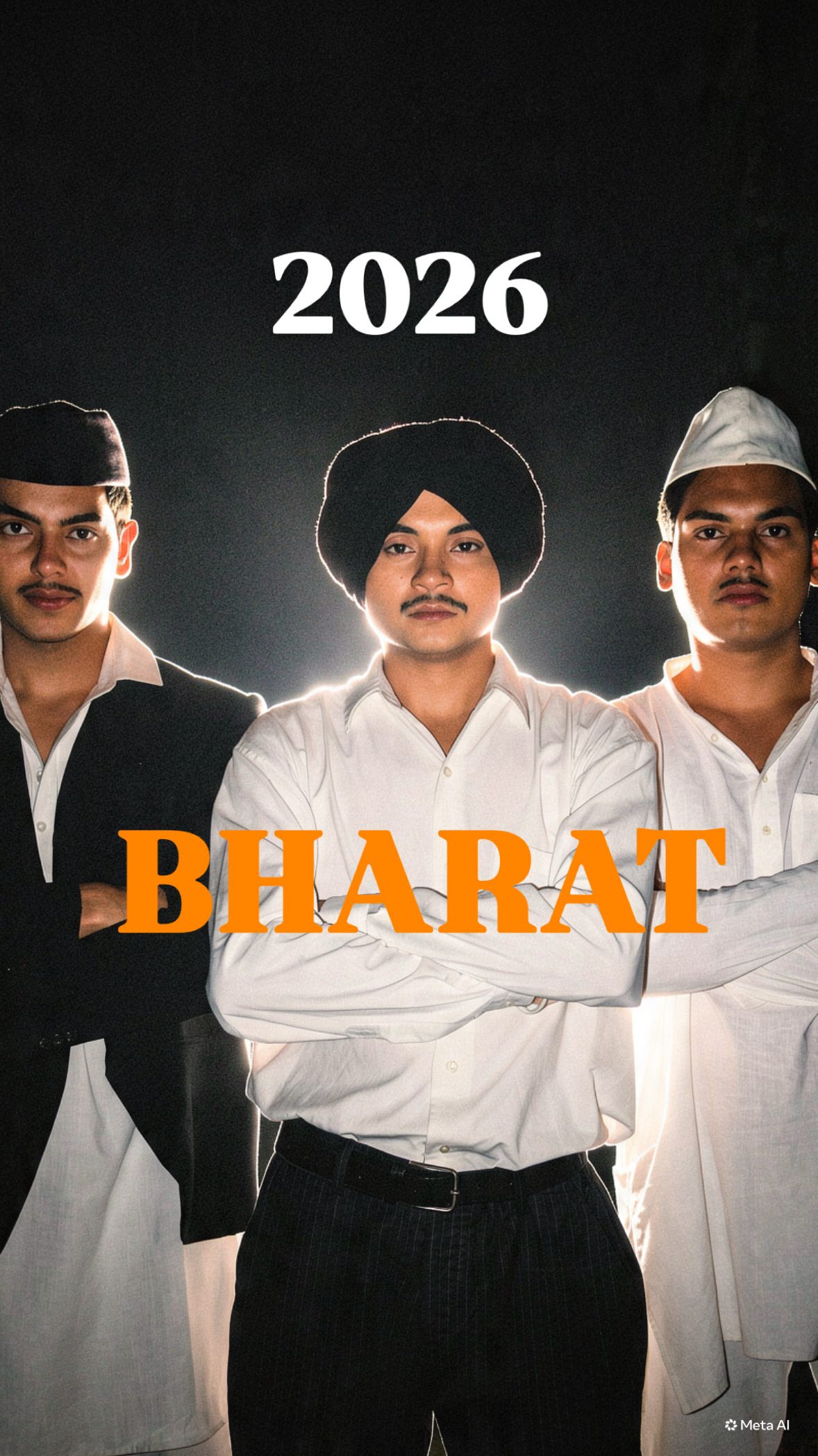
A 2026 reel imagines Bhagat Singh, Rajguru and Sukhdev asking whether independence delivered civic freedom
Aaditya Preeti’s 14 August 2026 reel imagines Bhagat Singh, Rajguru and Sukhdev returning to an independent India and questioning religious and caste division, inequality, justice and the freedom to dissent. The performance echoes constitutional ideals of liberty and equality and parts of Bhagat Singh’s documented criticism of religious orthodoxy and caste hierarchy, but its dialogue is a modern creative interpretation—not the revolutionaries’ own words or systematic evidence about India in 2026.
An Instagram reel published by Aaditya Preeti (@aadiyouaresosmartt) on 14 August 2026 stages actors as Bhagat Singh, Shivaram Rajguru and Sukhdev Thapar returning to India nearly eight decades after independence. It is a fictional, rhetorical performance—not historical footage and not a record of words spoken by the three revolutionaries.
The dialogue contrasts visible development with a broader idea of freedom. The characters remark on tall buildings and national progress, but ask whether people’s lives have risen with them. They describe religious and caste division as unfinished problems, welcome the ability to raise one’s voice for one’s rights, and frame freedom as including human dignity, justice for the poor, young people’s ability to question authority, and a patriotism compatible with questioning the country.
What the reel is—and is not
The reel’s immediate claims about contemporary India are mostly normative or broad social assertions rather than precise, testable statistics. Its device is counterfactual: it gives present-day lines to historical figures. Those lines should therefore be attributed to the creators, not to Bhagat Singh, Rajguru or Sukhdev.
There is, however, historical context for connecting Bhagat Singh with criticism of religious orthodoxy and caste hierarchy. In his 1930 essay Why I am an Atheist, Bhagat Singh explicitly described his atheism and criticised social hierarchy, including caste-based privilege. That supports a limited connection between the reel’s themes and parts of his documented thought; it does not establish that he would have used this script or reached every judgment the reel makes about India in 2026.
The larger issue: independence as a constitutional and civic project
The reel’s stronger public-interest value is the distinction it draws between political independence and the continuing quality of citizenship. India’s constitutional framework itself defines the republic through justice, liberty, equality and fraternity. Fundamental-rights provisions prohibit state discrimination on grounds including religion and caste, protect freedom of speech and expression, and protect freedom of conscience and religion subject to constitutional limits.
That makes the reel less useful as a factual verdict on “2026 India” than as a contemporary argument about the standards by which independence is judged. Infrastructure and economic development are one dimension of progress; equal citizenship, freedom to question, access to justice and protection from religious or caste discrimination are another. The existence of constitutional guarantees does not by itself prove that these ideals are fully realised, and this reel supplies no systematic evidence measuring the gap.
What can be concluded
The performance uses the memory of three anti-colonial revolutionaries to ask whether freedom should be measured only by the end of British rule and visible development, or also by citizens’ lived ability to exercise equality, dignity, justice and dissent. That question has a clear constitutional basis and, in Bhagat Singh’s case, some resonance with documented criticism of religious belief and caste hierarchy. But the script remains a modern creative interpretation: it cannot be treated as a quotation from, or definitive statement of the views of, Bhagat Singh, Rajguru or Sukhdev.
