MAIN MENU

CJP’s Jantar Mantar protests and the demand for answers: What election scrutiny and India’s protest history reveal
As CJP protesters challenge Gyanesh Kumar over voter-roll revisions, a reel contrasts today’s detentions with Vajpayee’s bullock-cart protest and dissent under earlier prime ministers. The key question is whether restrictions on assembly and the Election Commission’s responses meet democratic standards—without treating disputed fraud allegations as proven.
Listen to this article
Detecting language…
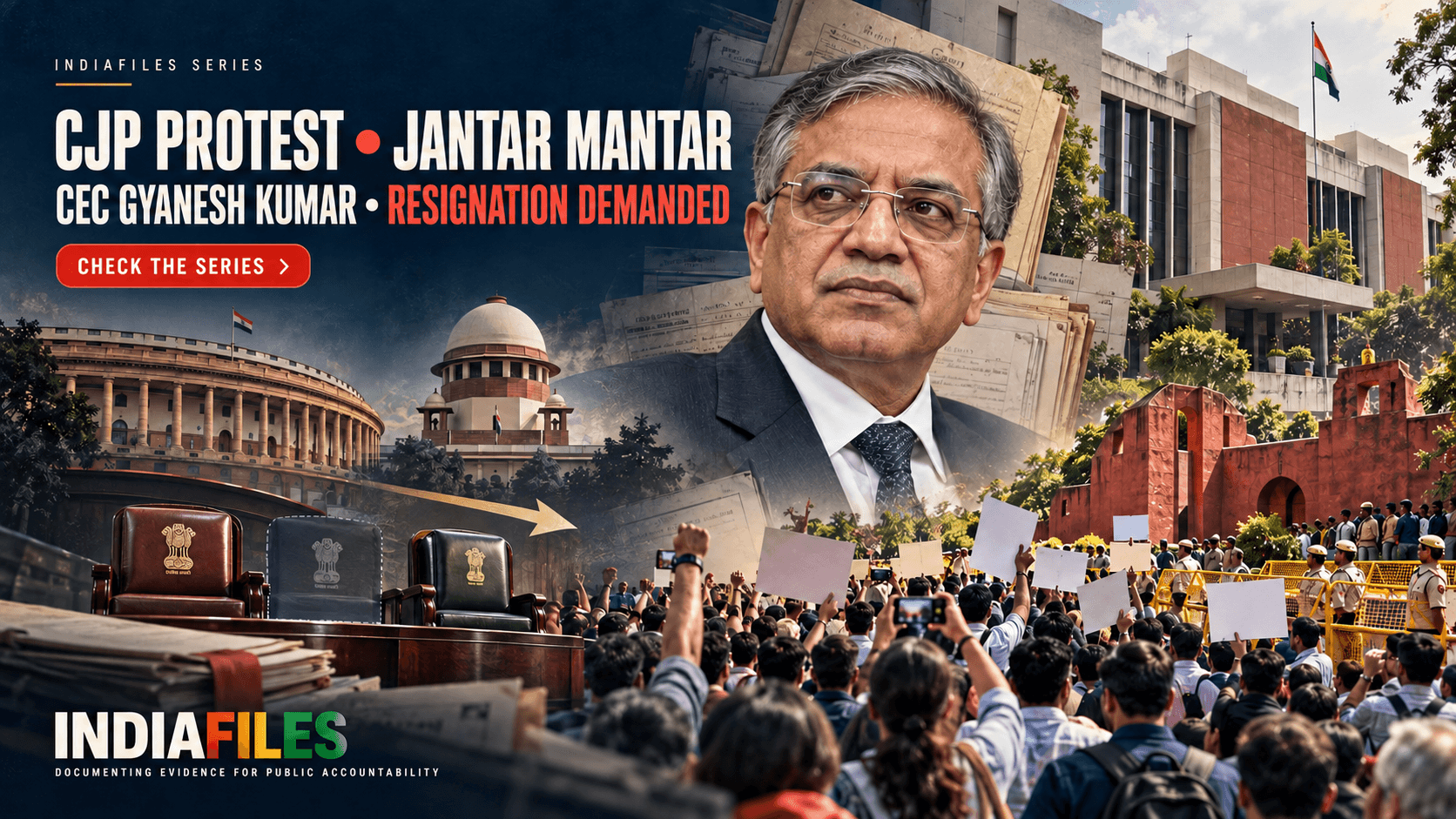
At Delhi’s Jantar Mantar, the Cockroach Janta Party (CJP) and other protesters have demanded the resignation of Chief Election Commissioner Gyanesh Kumar over changes to electoral rolls. Police restrictions and detentions have turned the dispute into a second question: how should the state respond when citizens challenge an institution responsible for free and fair elections?
In an Instagram reel published on 7 October 2026, commentator Abhay Raj (@rewirewithabhay) contrasts present-day detentions with opposition protests in earlier decades. He invokes Atal Bihari Vajpayee arriving at Parliament in a bullock cart, protests during Jawaharlal Nehru’s era, and black flags shown to Manmohan Singh. His central demand is that the Election Commission and Prime Minister answer public questions rather than allow policing to become the main response. That democratic argument deserves examination, but the reel’s statement that large-scale election fraud has already occurred is an allegation, not an established legal finding.
What brought CJP protesters to Jantar Mantar?
The immediate dispute is the Special Intensive Revision (SIR) of electoral rolls, which checks and updates voter lists. Large numbers of names have been removed from draft lists across states and Union Territories. The Election Commission says such exercises remove duplicate, deceased or relocated voters; critics fear eligible citizens have also been excluded and say some groups face a higher risk of losing their vote. The number of deletions cannot, by itself, establish how many were wrongful or who intended them.
On 24 September, CJP organisers including Abhijeet Dipke demanded Kumar’s resignation and announced an election-accountability campaign. They subsequently called for a Jantar Mantar demonstration on 10 October. Reporting by Reuters and other news organisations describes police detentions, restrictions on gatherings and subsequent demonstrations in Delhi. A further march in mid-October encountered prohibitory orders and a heavy police deployment. These are documented developments, although the legality and necessity of each specific detention must be assessed on its own facts.
Why the questions about the Election Commission are substantive
A September investigation by The Indian Express reported that Election Commissioners Sukhbir Singh Sandhu and Vivek Joshi had recorded objections on at least 14 occasions to decisions or procedures involving voter registration, deletion, software oversight and access to data. The Commission acknowledged the notes but described differing views as part of decision-making and maintained that its decisions had been unanimous. That response should be considered alongside the particular objections rather than treated either as proof of fraud or as a complete answer to each concern.
Petitions challenging parts of the process and the Commission’s functioning have reached the courts. The Supreme Court’s examination of electoral procedures, including questions about Form 6, is judicial scrutiny—not a judgment that election fraud occurred. In October the Court clarified that an earlier ruling had neither approved nor rejected a new version of Form 6 that did not exist at the time. Disputed decisions therefore warrant records, reasons, an opportunity to correct wrongful deletions and meaningful independent review. They do not justify describing every deletion as a stolen vote.
What the historical comparisons actually show
Vajpayee’s bullock-cart protest is grounded in historical reporting: in 1973 he travelled to Parliament in a bullock cart to protest higher fuel prices. The historical account cited here refers to petrol and kerosene; the reel’s precise ‘three paise on diesel’ detail has not been independently established and should not be repeated as fact.
The reel also refers to people confronting Nehru and JNU students waving black flags at Manmohan Singh. Those specific incidents and the claim that Singh personally answered the students have not been sufficiently corroborated here. Without records of their circumstances and the police response, they cannot prove that all earlier governments tolerated protest or that every modern restriction is unprecedented. India has a long history both of outspoken dissent and of governments restricting it. The meaningful comparison is whether the same constitutional standards are applied to protests regardless of who holds office.
When are protest restrictions justified?
Peaceful assembly and expression have constitutional protection, though authorities can impose lawful, proportionate restrictions for genuine public-order reasons. The government can regulate routes, numbers and access to sensitive buildings; protesters do not have an unlimited right to enter the Election Commission’s premises. But stopping a march or detaining people requires more than political embarrassment or broad claims of inconvenience. Officials should be able to identify the actual risk, explain why less restrictive arrangements were insufficient, apply the rules consistently and provide a route to challenge detention.
Delhi Police has relied on permission requirements, designated protest areas and prohibitory orders in responding to demonstrations. Protest organisers have disputed those measures. That disagreement needs case-specific scrutiny: a peaceful person holding a placard is not equivalent to someone threatening others or breaking through a barricade. Reported mass detentions and extensive restrictions, without a clear showing of individual necessity, are a serious and unjust interference with peaceful democratic participation. An alleged procedural breach may permit proportionate enforcement, but it does not remove the duty to respect fundamental rights.
What would meaningful accountability look like?
The Election Commission should publish clear, accessible explanations of contested procedures, the objections raised within the institution, decisions taken in response, and workable methods for wrongly excluded voters to restore their names before elections. Independent scrutiny should assess records and outcomes, not accept either the Commission’s assurances or protesters’ accusations as a substitute for proof.
The Prime Minister can address the controversy publicly, as the reel asks, but electoral administration remains the Election Commission’s constitutional responsibility; an address by a political leader cannot replace the Commission’s reasoned response or judicial review. Equally, opponents must distinguish documented procedural irregularities from the much more serious accusation of deliberate election rigging.
What the Jantar Mantar dispute reveals
By 18 October 2026, CJP’s campaign had moved beyond a single protest into repeated confrontations over voter-roll transparency and the right to demonstrate. The strongest supported conclusion is not that election fraud has been judicially proved. It is that significant documented questions about electoral procedures coexist with substantial restrictions and detentions affecting people seeking public answers. Unexplained or excessive restraints on peaceful protest are unjust, and the Election Commission owes reasoned, verifiable answers to citizens across party lines. Respecting both standards is necessary if public trust in elections is to be earned rather than demanded.