Entity Supreme Court of India

India’s apex constitutional court.

IndiaFiles is an independent, community-driven documentation and research platform that organizes publicly available information, records, and evidence on matters of public interest. You can contribute by joining as an approved contributor and submitting work for editorial review, or by asking our custom GPT to evaluate and, where appropriate, publish a post automatically.

Our purpose is to build a reliable, evidence-based public record—not promote a narrative. Contributors’ views are their own, opinions are clearly identified, and factual corrections or credible new evidence are always welcome.

CONTRIBUTE

Filters

Category
Tag
Entity
Geography
Type
Evidence
Period
Ranking
Author
Source
Sort by

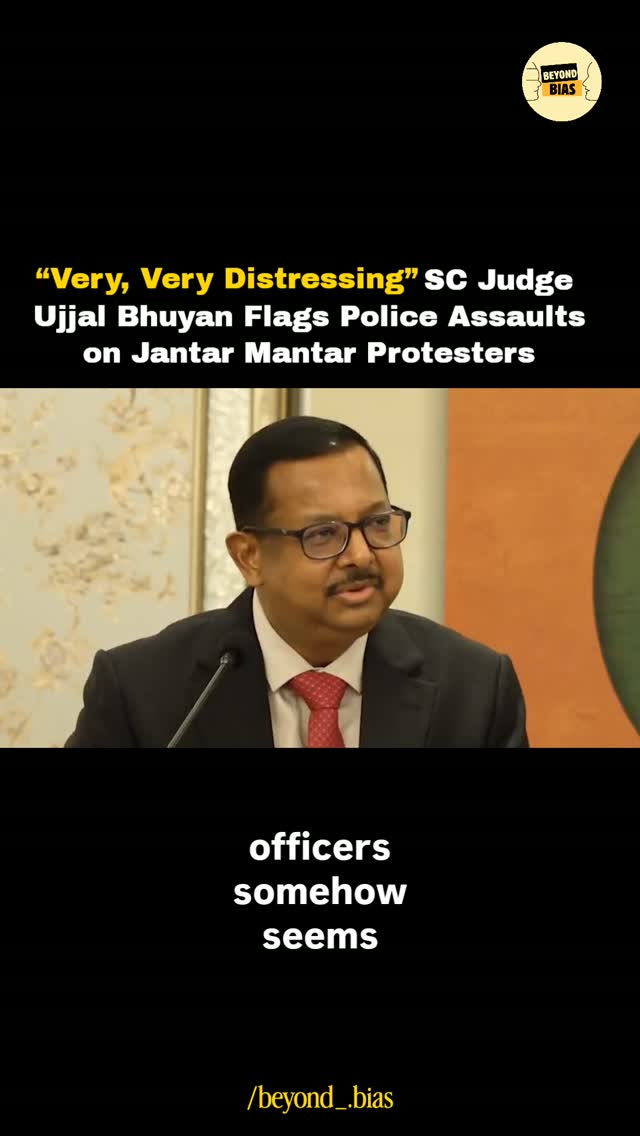
A Beyond Bias reel records Supreme Court Justice Ujjal Bhuyan calling police assaults on protesters “very, very distressing” and warning that professional detachment appears to be disappearing. Reporting corroborates his remarks, which place the July Jantar Mantar controversy inside a two-decade police-reform debate over professional independence, accountability and rights; they do not by themselves establish…

Justice Ujjal Bhuyan’s Jantar Mantar remarks connect protest-force concerns to the unfinished police-reform question
Open Post: Justice Ujjal Bhuyan’s Jantar Mantar remarks connect protest-force concerns to the unfinished police-reform question

A Hindustan reel from an event branded “9th Bihar Chhatra Sansad” argues that aspiring politicians should clear an “Indian Political Service” exam. India currently has no general education or competitive-exam requirement for MPs or MLAs; the deeper issue is whether competence screening would improve representation or exclude citizens from elected office.

Open Post: Viral call for a politicians’ exam raises a real qualification debate—but India’s elections currently impose no education test

In a 2026 reel, Avadh Ojha asks why citizens who demand competent professionals elect politicians with criminal backgrounds and argues that voters must hold representatives accountable. Election-affidavit data supports the wider concern: 46% of MPs elected in 2024 declared criminal cases, but pending cases are not convictions and the evidence does not establish Ojha’s claim…

Open Post: Avadh Ojha’s appeal to voters highlights the persistent criminalisation of Indian politics

The 2G record is not resolved by a single “scam” or “no scam” verdict. The 2017 criminal acquittals remain operative, while the Supreme Court separately held the 2008 licence-allocation process illegal and quashed it; the ₹1.76-lakh-crore figure was a presumptive audit estimate, not proven stolen cash. Keeping those findings distinct is essential to understanding what…

Open Post: The 2G record contains both criminal acquittals and a Supreme Court finding that the 2008 licences were illegal

In ANI's 16 April 2014 interview, Narendra Modi said that if allegations against him over the 2002 Gujarat riots were proven he should face exemplary punishment rather than be forgiven through apology; earlier in the same interview he separately proposed fast-track courts for criminal cases against MPs and MLAs. A 2026 reel merges those exchanges…

Open Post: Modi’s 2014 ANI interview separated punishment for proven guilt from decriminalising politics; viral reel merges the two

The 2026 Ayodhya Ram Temple donation investigation found prima facie evidence of cash theft and serious weaknesses in counting, CCTV and supervision, leading to an FIR and arrests. But the viral reel turns that specific accountability failure into a broader argument against donating to temples; the evidence supports scrutiny of donation governance, not a general…

Open Post: Ayodhya donation probe found theft indicators and control failures; it did not prove a general case against temple giving

Investigations into alleged theft from Ayodhya’s Ram Temple donations documented repeated suspected pilferage and failures in frisking, CCTV, supervision and cash-counting safeguards, followed by arrests, tighter controls and continuing judicial scrutiny. Abhinav Thul’s July satire captured that real governance scandal, but its “we loot our own temples” punchline is collective rhetoric, not a factual allegation;…

Open Post: Ayodhya donation theft exposed failures in Ram Temple counting safeguards; the viral satire captured a real governance scandal

Pappu Yadav’s 31 July Parliament skit drew an FIR and accusations of insulting Sanatan Dharma, but it responded to a real Ayodhya donation scandal in which investigators documented repeated suspected pilferage and serious counting, supervision and security failures. The viral reel is partly grounded in contrasting that scandal with religious-offence politics, though its meat-industry donation…

Open Post: Ram Temple donation failures preceded Pappu Yadav skit’s Sanatan-Dharma dispute

The 2025 Delhi High Court refusal was not the end of the bail story: in January 2026 the Supreme Court granted bail to five co-accused but kept Umar Khalid and Sharjeel Imam in custody after an accused-specific UAPA assessment. Their renewed appeals remain pending, highlighting the unresolved tension between prolonged pre-trial detention, Article 21 liberty…

Open Post: UAPA bail rulings split co-accused after years in custody; Khalid and Imam’s fresh appeals remain pending