MAIN MENU

At Delhi’s Tiranga March, an alleged ‘shoot the traitors’ slogan raises a question about dissent and intimidation
A reporter at the 16 October 2026 Connaught Place march says a counter-gathering chanted for ‘traitors’ to be shot. The allegation remains independently unconfirmed, but the documented counter-protest, police restrictions and electoral-roll dispute expose a central democratic distinction: questioning authorities is not disloyalty, and political disagreement cannot justify threats of violence.
Listen to this article
Detecting language…
At Connaught Place on 16 October 2026, people carrying the national flag assembled for the Lehra Do Tiranga march, called amid protests over electoral-roll revisions and restrictions on demonstrations in Delhi. A reporter in an Instagram reel published by Newsreel Asia that day described two nearby crowds. She said one group supporting the BJP and RSS had shouted “Desh ke gaddaron ko, goli maro saalon ko” — a call to shoot those branded traitors. Her question was simple: does challenging the Election Commission or defending the right to protest make someone an enemy of the country?
What the recording establishes — and what it does not
The reel documents the reporter making that allegation and reflecting on its meaning. Its published caption calls the alleged chanters right-wing goons and asserts an intention to incite violence. Those are the publisher’s descriptions, not independently established identities or motives. The available material does not conclusively identify each person alleged to have shouted the slogan, prove an organisational affiliation or independently establish that the quoted chant occurred in the stated encounter. It would therefore be wrong to present a criminal finding or attribute the words to an organisation as such.
There is stronger independent evidence for the surrounding confrontation. The Tribune reported protesters raising slogans against the Chief Election Commissioner while shopkeepers near Palika Bazaar’s Gate No. 2 gathered and shouted slogans supporting Prime Minister Narendra Modi. This confirms a political counter-demonstration at the march, not the particular threatening words alleged in the reel.
Why people gathered with the tricolour
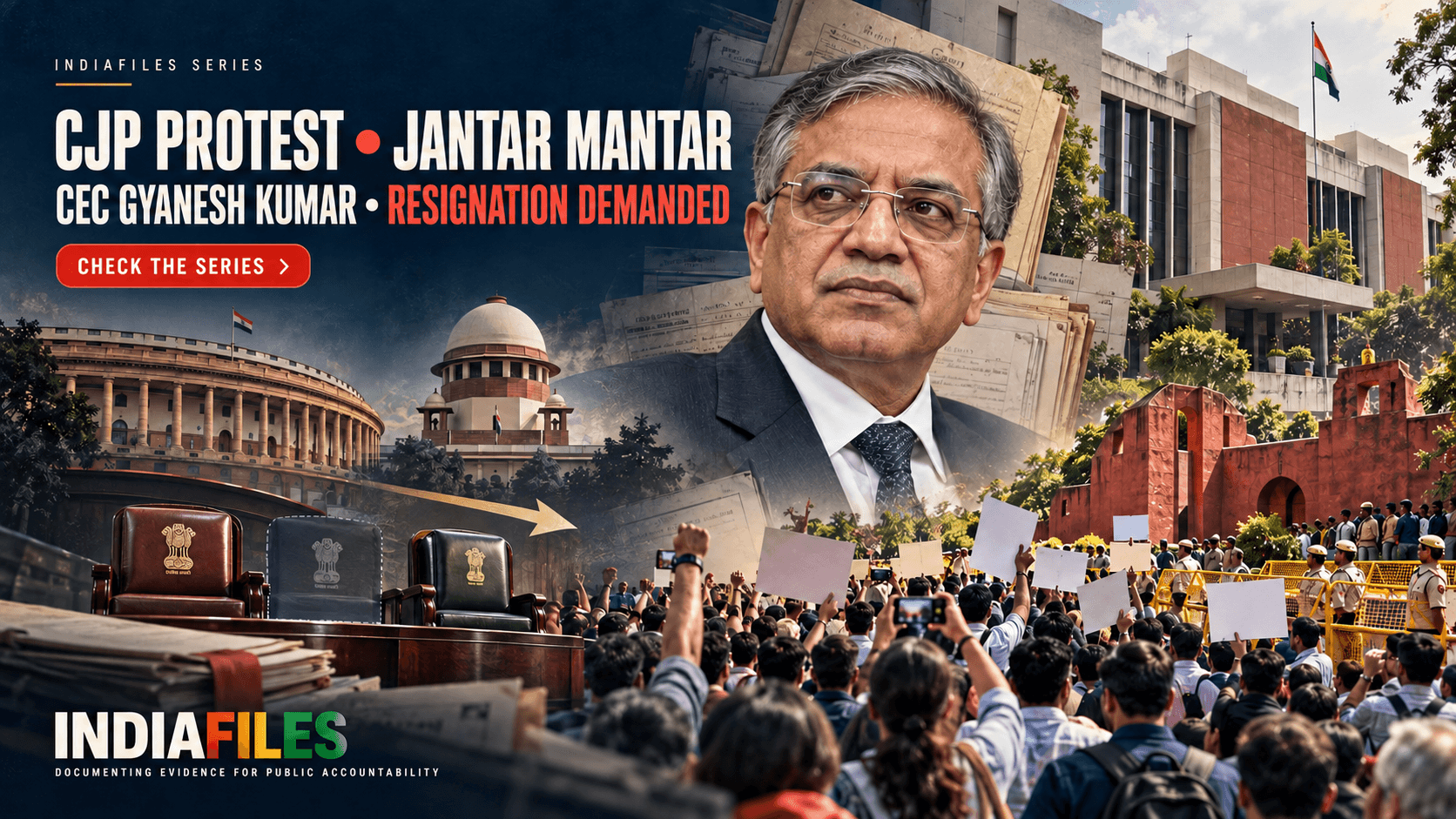
The march was called by the Cockroach Janta Party (CJP) and drew student activists and other citizens. Protesters objected to the Election Commission’s Special Intensive Revision of electoral rolls and demanded accountability from Chief Election Commissioner Gyanesh Kumar. They also opposed the removal of Jantar Mantar’s designation as a protest site. Reuters reported detentions of CJP founder Abhijeet Dipke and student leaders ahead of the gathering. The Indian Express reported participants questioning the heavy restrictions and saying they wanted to exercise democratic rights.
One numerical claim in the reel needs special care. The reporter referred to 13 crore names being removed from electoral rolls. Reuters and other agencies reported removals on a similar scale during the voter-list review, but the total is not proof that every removed entry belonged to an eligible person wrongly denied a vote. Authorities and the BJP dispute allegations that the exercise was politically manipulated. Whether particular deletions were improper requires examination of the relevant lists, reasons, appeal processes and individual cases. The underlying right to ask those questions does not depend on proving every protest claim correct.
Police restrictions and the right to protest
Ahead of the march, Delhi Police invoked Section 163 of the Bharatiya Nagarik Suraksha Sanhita to restrict assemblies; the New Delhi Municipal Council closed Central Park on 16 and 17 October. Police cited order, congestion and the absence of protest permission. Authorities also indicated that a smaller gathering with the flag and national anthem might be accommodated. The Indian Express reported more than 25,000 personnel deployed ahead of the planned march. These public-order reasons deserve consideration, particularly in a busy commercial area; traders also raised disruption concerns.
At the same time, Article 19 of India’s Constitution protects freedom of expression and peaceful assembly, subject to lawful and reasonable restrictions. Restrictions cannot be judged only by an official claim that they promote safety: their necessity, breadth, duration and the availability of workable alternative protest sites matter. Moving assemblies away from visible public locations may reduce disruption but can also weaken protesters’ ability to be heard. The presence of a tricolour does not override every lawful restriction; nor does the absence of permission make peaceful disagreement disloyal.
When disagreement is branded betrayal
The reporter’s central challenge exposes an important distinction. Citizens may criticise the Election Commission, dispute voting-list decisions, defend government policy or oppose a demonstration without surrendering their place in the nation. The same civic freedom applies to supporters and critics of the government. Calling someone an “anti-national” is political rhetoric, not an answer to their evidence or a legal finding.
If people did call for those labelled traitors to be shot, that conduct deserves clear condemnation: urging violence against political opponents is unjust and intimidates the exercise of democratic rights. It is not equivalent to a peaceful counter-protest. Whether the words constituted an offence in this particular incident depends on reliable evidence, context and the applicable legal standard; that has not been established here. The reporter’s allegation should be investigated rather than either accepted as proven or dismissed because it is politically charged.
What the Connaught Place encounter tells us
The 16 October march was not only a dispute over where a crowd could assemble. It brought together concerns about voter-list accountability, access to public protest spaces and competing ideas of patriotism. Reports establish that protesters, counter-demonstrators and police were all present amid detentions and restrictions. The specific alleged shooting chant remains uncorroborated by the independent reporting examined here. But the democratic principle does not depend on identifying a side as the only true patriots: a citizen does not become a traitor by asking whether the electoral system is fair, and threats of violence cannot be defended as ordinary disagreement.