MAIN MENU

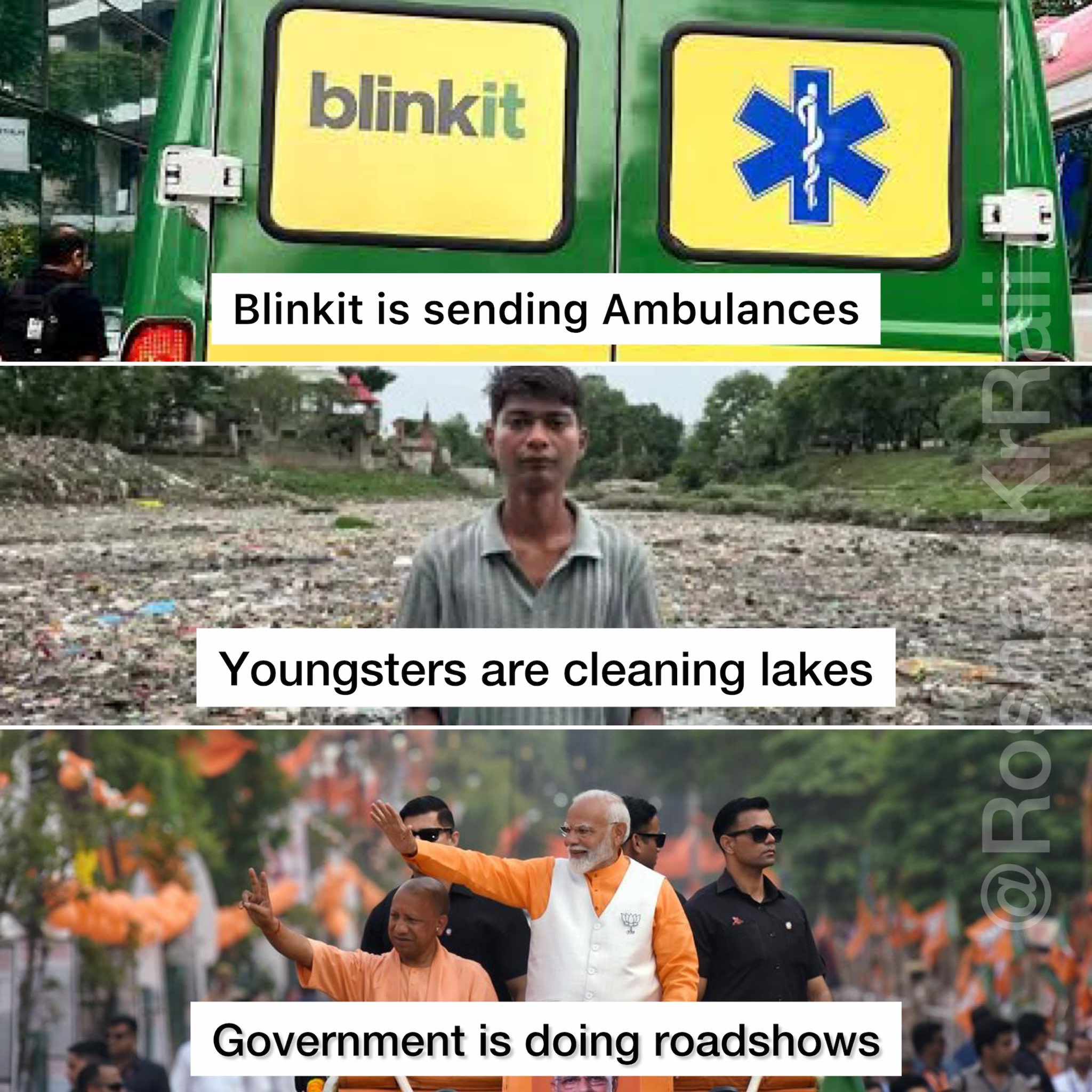
Meme contrasts Blinkit ambulances and Bittu Tabahi’s Ajnar River clean-up with government roadshows
An 8 September 2026 meme contrasts Blinkit ambulances and Bittu Tabahi’s clean-up with government roadshows. Reporting verifies that Bittu Tabahi, also reported as Surendra Singh Choudhary, spent months cleaning Madhya Pradesh’s polluted Ajnar River—the meme calls it a lake—but these examples do not establish that citizens and companies have replaced government provision or that roadshows caused service gaps.
An Instagram meme posted by the account Leftist (@lefttist) on 8 September 2026 uses three panels to make a political comparison: “Blinkit is sending Ambulances”, “Youngsters are cleaning lakes”, and “Government is doing roadshows”. The last panel shows Prime Minister Narendra Modi and Uttar Pradesh Chief Minister Yogi Adityanath during a political roadshow. The communicated message is not simply that these three activities exist; it implies that companies and young citizens are doing socially necessary work while government is preoccupied with political spectacle.
The first part of that contrast rests on a real development. Blinkit launched a basic-life-support ambulance pilot in Gurugram in January 2025 with five vehicles. The company later expanded the service, and its current ambulance page says it operates in Gurugram and selected parts of Delhi-NCR. Blinkit currently reports 27 ambulances, 7,837 “safe transfers” and an average response time of seven minutes. Those performance figures are company-reported rather than an independent audit.
The ambulance service also points to a genuine public-interest issue: gaps and unevenness in emergency medical transport. National Health Mission data cited by The Indian Express showed 17,495 operational basic-life-support ambulances as of December 2023, while reporting and health-policy commentary around Blinkit’s launch raised questions about ambulance quality, monitoring, coordination and the state’s responsibility for essential emergency care. A private service can supplement that system; its existence alone does not establish that government has abandoned ambulance provision.
The meme’s second panel refers to the viral clean-up associated with Bittu Tabahi, the online name used by young Biaora student Surendra Singh Choudhary. Independent reporting in September 2026 documents Choudhary spending months removing plastic, weeds and other waste from the polluted Ajnar River in Biaora, Rajgarh district, Madhya Pradesh, largely by hand and initially with limited equipment. Reporting also says the Biaora municipality later provided mechanical assistance. The meme calls the waterbody a “lake”, but the independently documented project is the Ajnar River. IndiaFiles can verify the underlying clean-up and the person associated with it from reporting; the submitted meme alone does not independently establish the identity of the person visible in its photograph.
The Ajnar case makes the citizen-action element of the meme substantially more concrete than previously stated. It shows an individual undertaking sustained clean-up work on a polluted public waterbody before receiving wider attention and municipal assistance. It still does not, by itself, establish that government across India has transferred waterbody maintenance to citizens. Reporting on the episode also contains competing accounts about how much of the river’s improvement should be attributed to Choudhary alone, which is another reason not to turn one striking example into a nationwide conclusion.
The third panel is also a rhetorical compression. Indian governments and political leaders do conduct roadshows and campaign events, but a photograph of one roadshow does not show what government as a whole is “doing” instead of providing emergency care or maintaining water bodies. Public agencies simultaneously fund and operate health, sanitation, environmental and other services. The comparison therefore cannot support a causal claim that roadshows caused deficiencies in ambulances or river maintenance, nor does it quantify public spending or administrative attention across those functions.
What the meme gets at
The stronger issue behind the graphic is how responsibility for essential public services is shared—and sometimes visibly supplemented—among the state, private firms and citizens. Blinkit’s ambulance expansion is concrete evidence that a commercial platform sees demand for fast urban emergency transport. Bittu Tabahi’s documented Ajnar River effort is a concrete example of citizen initiative addressing a polluted public waterbody. These developments can expose service gaps or create useful alternatives, but they do not by themselves measure government failure.
The democratic accountability question is therefore narrower than the meme’s punchline: when private companies or citizens step into service gaps, what coverage, quality, affordability and accountability remain guaranteed by public institutions? For emergency medical care, response time and clinical capability can affect survival; for polluted rivers, responsibility can span municipal waste management, sewage infrastructure, environmental regulation and public behaviour.
The evidence supports both the Blinkit ambulance example and Bittu Tabahi’s Ajnar River clean-up, while correcting the meme’s description of the waterbody as a lake. It does not establish a nationwide pattern of citizens and companies replacing government, or prove that political roadshows are the cause of service shortcomings. The meme works as political opinion built around real examples, but its three-panel comparison is not a measured account of government priorities.
