MAIN MENU

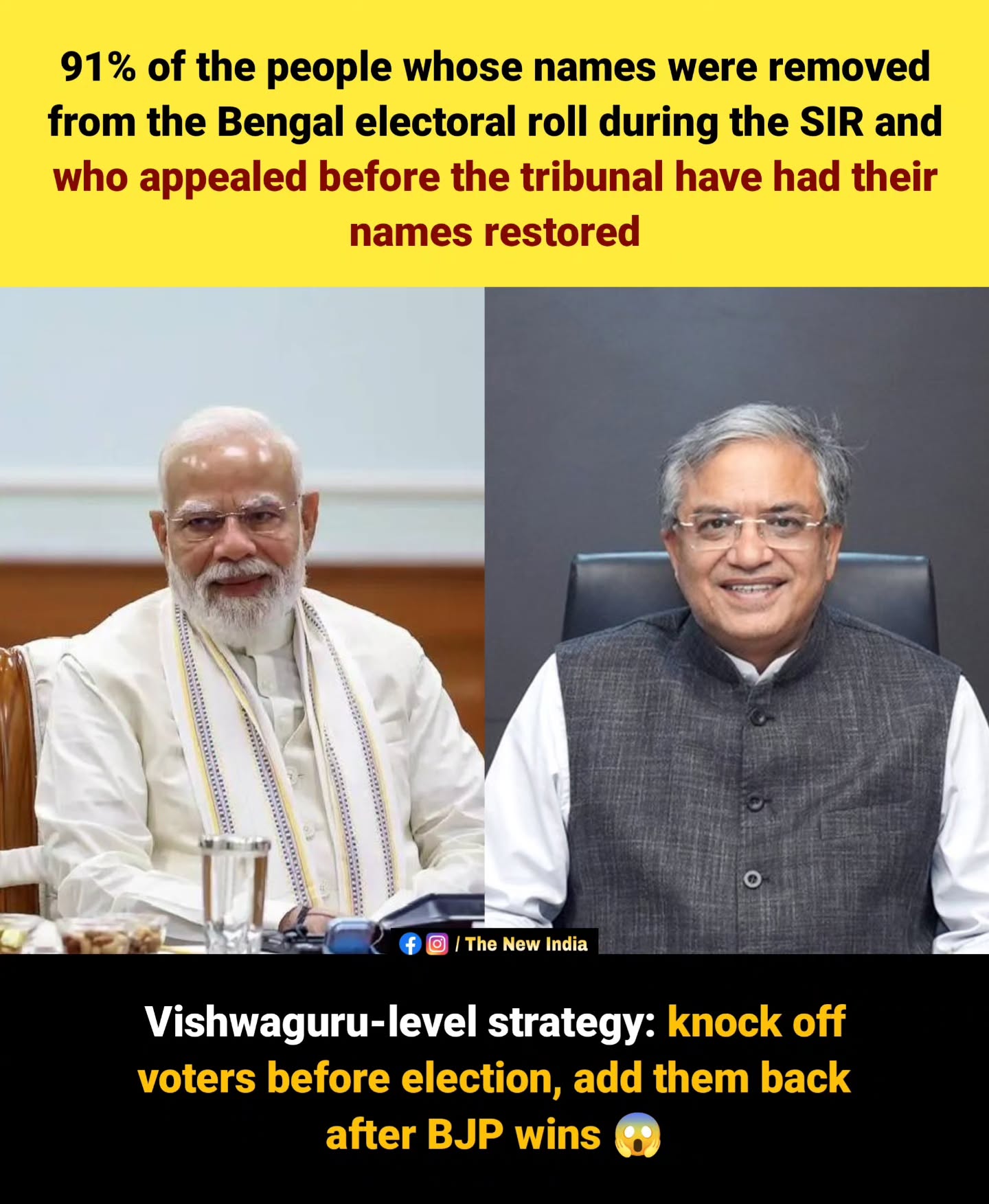
The New India’s Bengal SIR graphic uses a real 91% restoration figure, but its BJP strategy claim is unproven
The New India’s graphic cites a real figure: 75,443 of 82,782 West Bengal SIR appeals with recorded outcomes had resulted in inclusion/restoration, about 91%. But only a small share of the wider appeals pool had been decided, and the evidence reviewed does not establish the graphic’s allegation that voter removals and later restorations were a BJP election strategy; the supported issue is the accuracy and timeliness of electoral-roll safeguards.
An Instagram graphic posted by The New India (@thenewindia2) on 27 August 2026 says that “91% of the people whose names were removed from the Bengal electoral roll during the SIR and who appealed before the tribunal have had their names restored.” It then labels this a “Vishwaguru-level strategy” to remove voters before the election and add them back after a BJP victory. The post caption calls it “The biggest scam of India’s electoral history.”
What the evidence establishes
The 91% figure has a factual basis, but the graphic states it too broadly. An Election Commission RTI response obtained by Congress MP Isha Khan Choudhury showed that, as of 7 August 2026, West Bengal’s SIR appellate tribunals had recorded outcomes in 82,782 appeals. Of these, 75,443 resulted in inclusion/restoration and 7,339 in exclusion. That is about 91.13% of the appeals decided by that date, not 91% of everyone removed during the SIR or 91% of all appeals.
The denominator matters. Reporting on the RTI data says 38,10,620 appeals had been filed while only 82,782 had been disposed of—about 2.17%, leaving roughly 97.83% pending at that point. Subsequent submissions before the Supreme Court also distinguished appeals by excluded voters seeking restoration from the much larger number of challenges to voters who had been included. Reporting cited roughly seven lakh restoration appeals and about 31 lakh challenges to inclusions. The aggregate 38.10-lakh figure therefore cannot be read simply as 38.10 lakh deleted voters asking to be restored.
The larger issue is the reliability and timeliness of voter-roll safeguards
The unusually high restoration share among the cases decided is significant because it shows that many challenged exclusions reaching a completed appellate outcome were reversed. That raises a legitimate public-interest question about the accuracy of initial SIR exclusion decisions and, separately, whether an appeal system can protect voting rights effectively when most cases remain unresolved for long periods.
But this evidence does not establish the graphic’s allegation that voters were deliberately removed so that the BJP could win and then restored afterward. A high reversal rate, the timing of restorations, or a politically consequential outcome can justify scrutiny of process and institutional safeguards; they do not by themselves prove a coordinated electoral strategy, partisan motive, or that the reversals changed the election result. No evidence reviewed for this record demonstrates that alleged mechanism or intent.
Assessment
Partly supported, materially misleading in its political conclusion. The graphic is anchored in a genuine statistic: 75,443 of 82,782 appeals with recorded outcomes resulted in inclusion/restoration, around 91%. Its wording obscures that these were only the cases disposed of by the reporting date and that the wider appeals pool included different kinds of challenges. Its further claim that this was a BJP election strategy is an allegation unsupported by the evidence reviewed.
The defensible significance is narrower but important: the available data expose a large gap between the number of appeals and the number resolved, alongside a high reversal rate among resolved cases. Together these figures warrant scrutiny of how electoral-roll exclusions were made, how quickly mistakes could be corrected, and whether appellate safeguards operated in time to protect eligible voters. They do not establish who intended any errors, why they occurred, or the electoral effect.
Sources
- The New India Instagram post, 27 August 2026.
- The Indian Express, reporting the Election Commission RTI response, 26 August 2026.
- Bar & Bench, on tribunal disposal and pending appeals, 27 August 2026.
- Hindustan Times, on the Supreme Court proceedings and composition of appeals.
