MAIN MENU

Delhi’s Tiranga March: Why Neha Bora and Abhijeet Dipke were detained, and where police powers meet protest rights
Neha Bora and Abhijeet Dipke were detained during Delhi’s 16 October 2026 Tricolour march. Police cited crowd restrictions and public-order risks; the circumstances of Dipke’s immediate detention raise a sharper question about when prevention becomes excessive restraint on peaceful dissent.
Listen to this article
Detecting language…
On 16 October 2026, police detained student leader Neha Bora and Cockroach Janta Party (CJP) founder Abhijeet Dipke as supporters gathered in central Delhi for a march called Lehra Do Tiranga (Wave the Tricolour). The episode prompted an angry response from commentator Dhruv Rathee, who asked whether carrying India’s national flag had become a crime and compared the detentions to colonial-era repression. The important question behind that accusation is more specific: why were these protesters stopped, and was taking them into custody necessary?
What happened to Dipke and Bora?
Dipke had announced a gathering at Connaught Place’s Central Park. Police served him a notice earlier that day prohibiting the event. According to eyewitness reporting by The Indian Express, he left the house where he was staying at about 4.50 pm, was surrounded by journalists, and was stopped by officers within minutes. He asked what rule he had broken, said he was alone, and unfurled the Tricolour before being put into a police vehicle.
Bora, president of the All India Students’ Association (AISA), was also detained in connection with the march. Supporters said they could not locate her for several hours and complained that she lacked timely access to legal help. Police later said she had been held under preventive provisions and was released early on 17 October after formalities under Section 65 of the Delhi Police Act. The footage in Rathee’s Short conveys an aggressive police response, but the clip alone does not establish the exact number of officers used, every action surrounding Bora’s detention or the full circumstances of any physical force.
The march went ahead despite the restrictions. Protesters carrying Indian flags gathered in and around Connaught Place, while police detained more than 100 people and dispersed groups later in the evening. The immediate detentions and wider police operation are independently documented; the claim that the authorities treated flag-waving itself as an offence is a different proposition.
Why did police stop the march?
The notice served on Dipke said the public gathering had been announced without permission. It cited orders under Section 163 of the Bharatiya Nagarik Suraksha Sanhita (BNSS), which permits urgent restrictions to prevent danger or serious public disorder. Police pointed to Connaught Place’s busy roads, large numbers of shoppers and commuters, access for emergency vehicles, proximity to sensitive government areas, and alleged trouble at earlier CJP demonstrations. They said alternative approved protest venues could be used.
Those are real kinds of public-safety interests. Protecting commuters, businesses and emergency access is a legitimate police duty. But an official notice records the police’s stated assessment; it does not by itself prove that every detention or use of force was needed. Organisers said they intended peaceful protest, and Dipke repeatedly argued that stepping outside alone with a flag was not an offence. Police also described his action as preventive, not punishment for a proven criminal offence. They later said proceedings involved BNSS Sections 126 and 170, concerned with keeping the peace and preventive arrest.
Does peaceful protest require permission?
Article 19 of the Constitution protects speech and peaceful assembly. It also permits reasonable restrictions in the interests of public order. This means citizens do not have an unrestricted right to hold any size of march at any location. Nor does the existence of a prohibitory order give police an unlimited right to detain individuals or block all effective avenues of peaceful dissent.
The Supreme Court has recognised both sides of that balance. Its decisions on protests at Jantar Mantar and Shaheen Bagh accept regulation of shared public spaces, while its rulings on preventive restrictions require necessity and proportionate action. A relevant test is whether a concrete danger could have been handled through a smaller measure: conditions on the route, a cap on attendance, a suitable nearby venue or targeted crowd control instead of sweeping restraint.
That distinction matters especially in Dipke’s case. The publicly reported moment of detention occurred just after he left a residence, rather than after any documented violence by him on the road. Police had advance notice of his intended participation in a prohibited gathering, but the reports available so far do not demonstrate why custody at that precise point was indispensable. On that evidence, the immediate detention appears excessive. This is an assessment of the publicly established conduct, not a court ruling that the detention was illegal; the complete orders and police records would be needed for a final legal judgment.
What was the protest about, and what happened next?
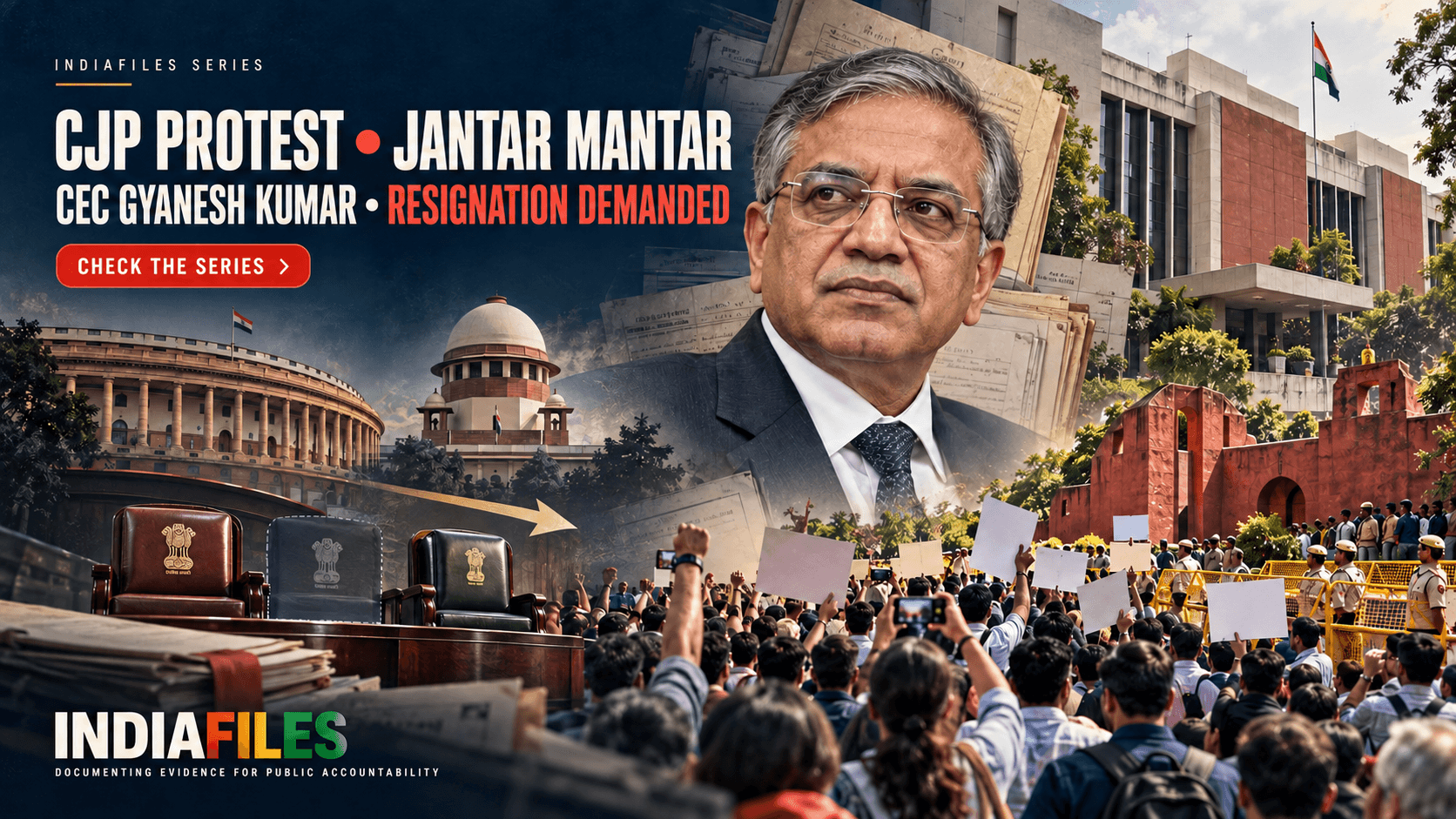
The Tricolour march was part of the CJP-led campaign challenging the Election Commission’s handling of electoral-roll revisions and demanding the resignation of Chief Election Commissioner Gyanesh Kumar. Protesters also sought the release of CJP members Saurav Das and Ashutosh Ranka, taken into custody earlier that week. Their complaints about wrongful voter deletion and official bias remain allegations where particular wrongdoing has not been independently established; the government and ruling BJP reject accusations of politically motivated manipulation.
Bora was released early on 17 October. Dipke was subsequently released on a conditional bond requiring him to maintain the peace for a year, according to reporting on 18 October. Release under such conditions is not a finding that his political criticism was unlawful, nor does it settle the legality of the original police action.
The Short’s description of Narendra Modi as a ‘traitor’ or ‘anti-national’ is political condemnation by its speaker, not an established fact or legal finding. No evidence reviewed establishes that the Prime Minister personally directed these detentions. Its comparison with British rule is rhetorical, not proof that the legal and historical circumstances are equivalent.
What this episode establishes
The strongest documented finding is not that India has criminalised carrying its flag. It is that Delhi Police used advance restrictions and preventive detention to stop named participants in a proposed political march, including a man who was taken into custody minutes after walking out with the Tricolour. Police had legitimate reasons to plan for crowd safety, but the available record does not adequately justify that immediate restraint as the least restrictive option. Treating peaceful dissent in this way is an unjust burden on citizens’ freedom unless a specific, necessary safety reason can be demonstrated. Clear orders, timely information about detainees, access to legal assistance and independent scrutiny are essential to determine whether police authority remained within lawful limits.