MAIN MENU

CJP protest: Videos of men carrying sticks raise questions alongside Delhi’s mass detentions
Ahead of the 10 October CJP protest, a reel alleged that men carrying sticks threatened demonstrators while police detained journalists and organisers. Reporting confirms widespread detentions, but the men's identities, alleged threats and police response remain unverified—an important distinction when judging equal protection of peaceful assembly.
Listen to this article
Detecting language…
A 9 October 2026 Instagram reel by INDIANEWS124 contrasts two things: claims that men openly carrying sticks threatened people planning to join a Cockroach Janta Party (CJP) protest, and police restrictions on journalists, organisers and peaceful demonstrators ahead of the 10 October gathering in Delhi. Its central question is whether authorities were acting firmly against people seeking to protest but not against those allegedly intimidating them.
That is a serious question about equal protection and public safety. But the two parts of the reel do not have equal evidentiary support. Independent reporting establishes extensive police restrictions and detentions. The identity of the men shown in the reel, the date and place of that footage, their exact words and any police action or inaction against them have not been independently established here. The clip should not be used to accuse identifiable people of specific crimes or political affiliations without further evidence.
What happened around the 10 October protest?
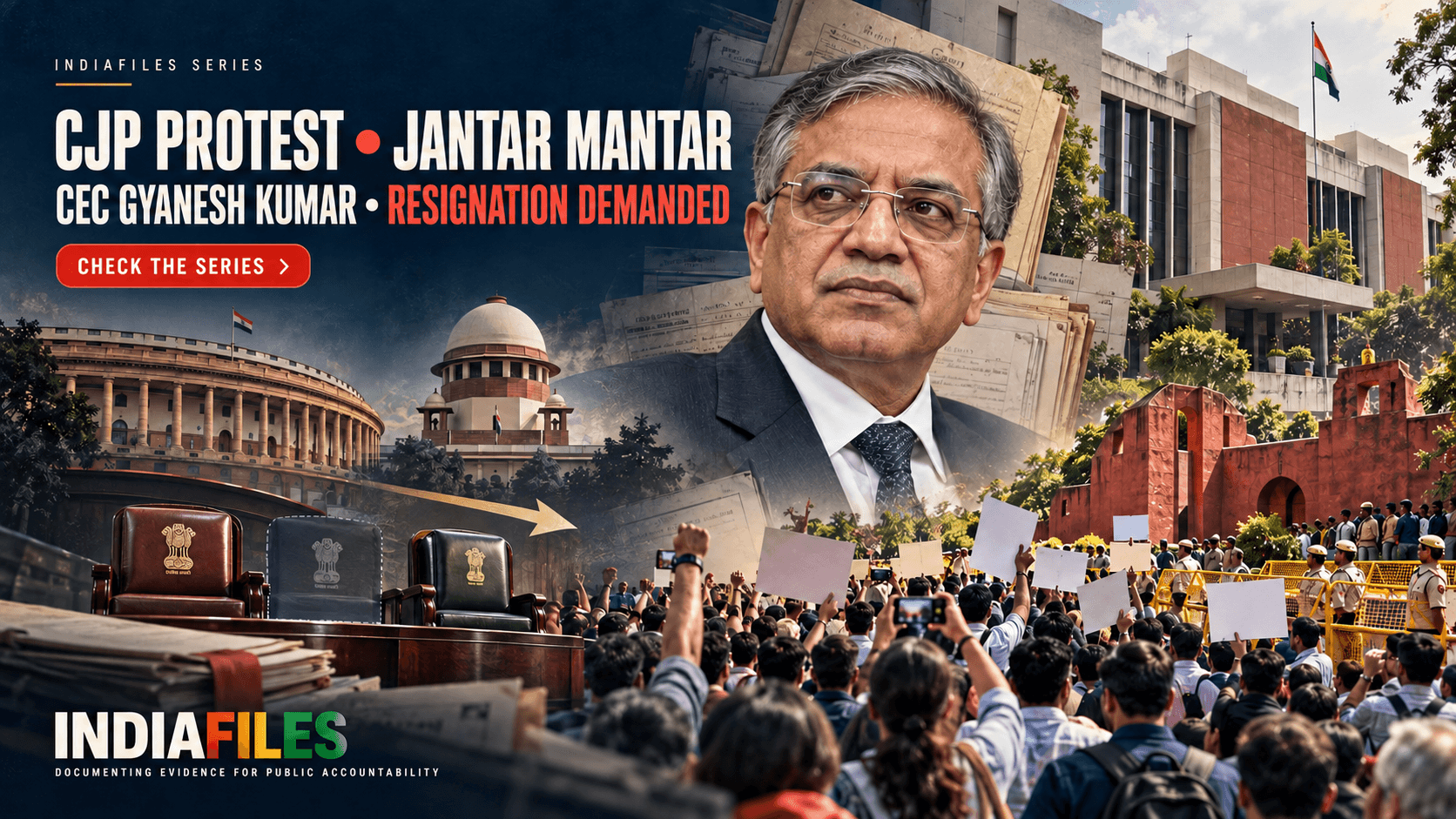
CJP and supporting groups planned a protest in Delhi demanding the resignation of Chief Election Commissioner Gyanesh Kumar over disputed electoral-roll revisions. The demand and accusations about the revisions are political allegations, not established findings of election manipulation. The Election Commission has denied bias.
Delhi Police refused permission for the gathering at Jantar Mantar, citing concerns about public order, earlier protest conduct, application requirements and restrictions under Section 163 of the Bharatiya Nagarik Suraksha Sanhita (BNSS). The provision permits written preventive orders in specified urgent circumstances involving danger or disturbances; it does not automatically prohibit every gathering everywhere. The necessity and reach of the particular orders still require examination.
On 10 October, Reuters reported more than 2,000 detentions and extensive controls on movement in Delhi. The Indian Express and Hindustan Times also documented barricades, checks and the detention of organisers, protesters and some journalists. Those reports provide a substantially firmer basis for discussing the scale of the police response than the reel alone.
What is known about the alleged threats?
The reel’s caption says social-media videos showed men with sticks threatening to confront protesters. An image of people holding sticks cannot, by itself, establish their intentions, an unlawful threat, their identity, or when and where it was filmed. Nor can the absence of publicly available reporting about an arrest prove that no investigation or police action occurred. Independent footage with full audio, a reliable original upload, a specific complaint or police record would be needed to evaluate the allegation accurately.
There are also separate reports of clashes and stick-carrying individuals during the demonstrations, including allegations of violence involving protesters. Those accounts should be investigated on their own facts; they do not identify the people in this particular pre-protest reel or settle its accusation of selective policing.
What equal policing should mean
Police have a legitimate duty to stop credible violence, including threats against demonstrators, and to prevent danger to bystanders. They can impose lawful, necessary restrictions on assemblies. But a peaceful protest is constitutionally protected expression, not itself evidence of violence. Restrictions should be based on concrete risks, applied fairly and limited to what safety requires. The same standard should apply to people threatening protestors and to demonstrators accused of violating lawful directions.
The documented scale of preventive detentions warrants scrutiny, particularly where journalists were stopped while covering events. Detaining a reporter merely for reporting, without a lawful and necessary basis, is unjust because it interferes with the public’s ability to learn what the authorities are doing. The fact that police cited public order does not settle whether every detention was justified. Equally, the allegation that men with sticks were left alone cannot be treated as proven without checking the specific incident and police response.
What happened afterwards, and what remains unanswered?
The dispute continued after 10 October. Police subsequently removed Jantar Mantar from the list of designated protest sites. On 15 October, the Supreme Court sought responses to a challenge against that change; seeking responses is not a final ruling against the authorities. CJP demonstrations and detentions continued later in the month. Reporting on detained protesters also carried allegations of mistreatment, with medical documentation in some cases; these require investigation rather than automatic acceptance or dismissal.
The strongest supported finding is narrower than the reel’s accusation but still important: large-scale restrictions on a protest and reporting around it did occur, and police must be able to justify their necessity and fair application. The specific claim that authorities ignored identifiable men threatening CJP protesters remains unresolved. Establishing that would require the original footage, the alleged threatening words and incident details, and records of complaints and official action. Protecting peaceful protesters against genuine intimidation while avoiding arbitrary detention is not a favour to one political side; it is part of equal enforcement of the law.