MAIN MENU

Justice Ujjal Bhuyan’s Jantar Mantar remarks connect protest-force concerns to the unfinished police-reform question
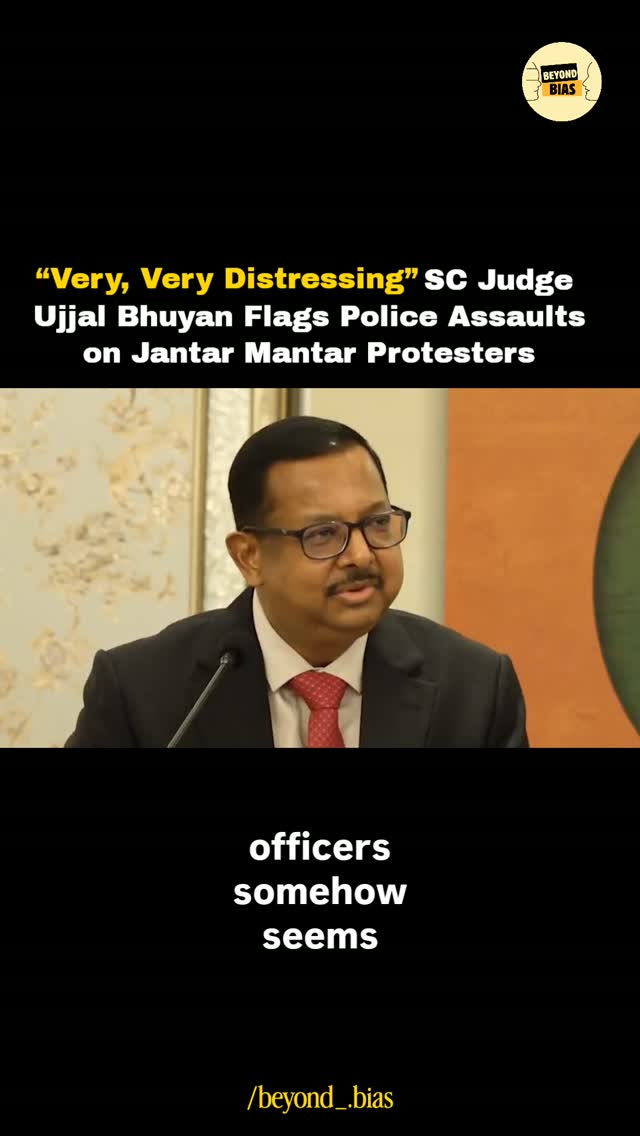
A Beyond Bias reel records Supreme Court Justice Ujjal Bhuyan calling police assaults on protesters “very, very distressing” and warning that professional detachment appears to be disappearing. Reporting corroborates his remarks, which place the July Jantar Mantar controversy inside a two-decade police-reform debate over professional independence, accountability and rights; they do not by themselves establish individual liability or who ordered particular uses of force.
A Beyond Bias Instagram reel posted on 5 September 2026 shows Supreme Court judge Justice Ujjal Bhuyan speaking about police conduct after the July student protests at Delhi’s Jantar Mantar. At the launch of retired IPS officer Yashovardhan Azad’s book Policing the Republic, Bhuyan said it was “very, very distressing” to see young IPS officers personally assaulting protesters and demonstrators and said the professional detachment expected of police appeared to be disappearing.
What Bhuyan said
Contemporary reports from the event corroborate the reel’s central account. Bhuyan argued that effective policing does not require excessive force or infringement of human rights and linked police credibility to constitutional conduct, impartiality, integrity and the rule of law. He also discussed custodial violence, extra-judicial killings, political interference and the long-running need for police reform.
The remarks followed the 20 July 2026 NEET-related student mobilisation at Jantar Mantar and the attempted march towards Parliament. That confrontation had already produced competing accounts of protester and police conduct, injuries on both sides and allegations of excessive police force. The Supreme Court subsequently took up questions around the protest policing and preservation or independent scrutiny of evidence. IndiaFiles has separately documented the July 20 confrontation and its evidentiary limits.
The core issue is larger than one protest
Bhuyan’s speech matters beyond the immediate Jantar Mantar episode because he placed crowd-control conduct inside a broader institutional question: whether police can exercise coercive power while remaining professionally independent, accountable and bound by constitutional safeguards.
That question is not new. In Prakash Singh v Union of India in 2006, the Supreme Court said police reform could no longer wait and issued directions intended to strengthen professional independence and accountability, including state security commissions, minimum tenure protections, separation of investigation from law-and-order functions and police complaints authorities. The judgment itself recorded concerns about political pressures, arbitrary transfers and the need for police to function as an impartial agent of law.
Two decades later, implementation remains an active institutional issue rather than a settled reform. Bhuyan’s September remarks therefore connect a disputed episode of protest policing to a longer-running problem the Supreme Court has itself addressed: how to make policing effective without weakening rights, professional independence or public accountability.
What the evidence supports — and what it does not
The submitted reel accurately reflects Bhuyan’s reported remarks at the book launch, and multiple independent reports corroborate the central quotations and context. The July protest provides the immediate background, while the 2006 Prakash Singh judgment independently establishes that police independence and accountability have been longstanding subjects of Supreme Court-directed reform.
The evidence does not establish from Bhuyan’s speech alone which individual officers committed unlawful acts on July 20, who ordered particular uses of force, or whether any specific officer is legally liable. Nor does the persistence of police-reform disputes by itself prove that incomplete reform caused the conduct alleged at Jantar Mantar. Those are separate questions requiring evidence about particular actions, commands and legal findings.
Synthesis: Bhuyan’s intervention is significant as more than criticism of a single protest response. It shows a sitting Supreme Court judge publicly framing protest policing, custodial violence and political interference as connected questions of professional policing and rule-of-law credibility. The institutional mechanism he invoked has a documented history in the Supreme Court’s own police-reform jurisprudence; responsibility for particular July 20 acts remains subject to case-specific evidence and adjudication.
