MAIN MENU

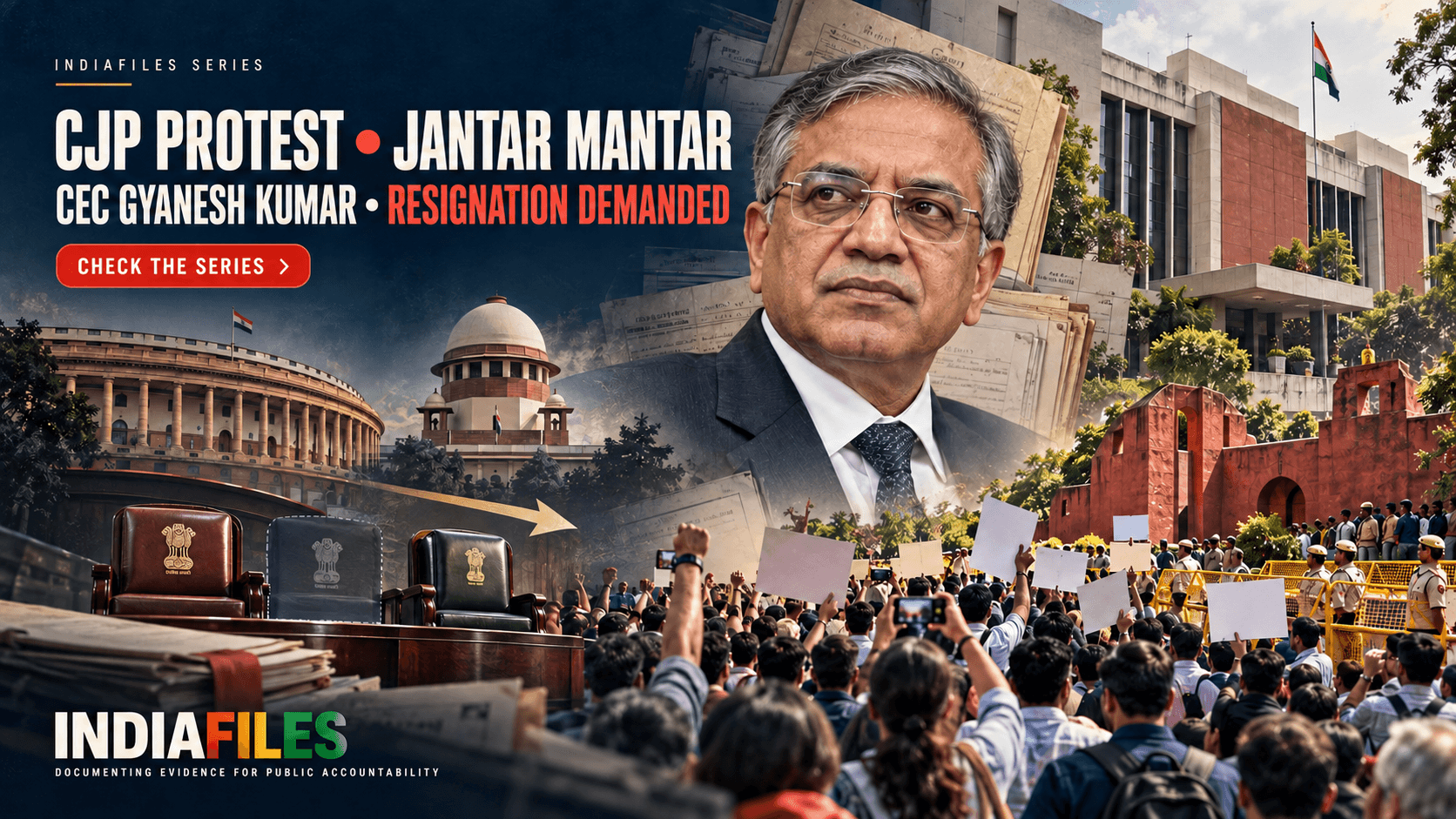
CJP’s Protests Against the Election Commission: The Complete Picture
From the 2023 election-commissioner appointment and legal-protection framework to voter-roll disputes, Delhi's CJP protests, detentions, the Tiranga March and a London demonstration, these connected records examine electoral accountability and the treatment of peaceful dissent. Verified restrictions and reported internal objections do not by themselves prove deliberate vote theft or politically directed suppression.
Listen to this article
Detecting language…
The CJP protests against the Election Commission emerged amid growing concerns over its independence, functioning and accountability. Changes to election commissioners’ appointment rules and legal protections in 2023 were followed by allegations of voter-roll irregularities and reports of objections raised within the Commission itself.
As demands for answers intensified, the controversy moved onto the streets. Denied protest permissions, preventive detentions and difficulties faced by journalists drew attention to the limits on peaceful assembly and independent reporting. Later Tiranga March demonstrations, competing political slogans and a solidarity protest in London broadened the debate about the treatment of dissent. These developments connect electoral accountability with the response to public protest, without establishing allegations of deliberate vote theft, coordinated political suppression or wrongdoing by every person accused.
1. Institutional backdrop: the 2023 executive-majority appointment panel
How the 2023 Election Commissioner appointment law gave the government a 2–1 advantage—and why independence is at stake
The Supreme Court's March 2023 interim panel included the Chief Justice of India. Parliament's later law replaced the CJI with a Cabinet minister nominated by the Prime Minister, giving the government side two of three seats. What the change means for independent elections, and where the 2026 court challenge stands.
No comments on How the 2023 Election Commissioner appointment law gave the government a 2–1 advantage—and why independence is at stake
2. Legal backdrop: Section 16 protections and claims about parliamentary scrutiny
Did the 2023 Election Commission law shield commissioners as Opposition MPs were suspended? What Section 16 actually does
A reel links the 2023 suspension of Opposition MPs to legal protection for Election Commissioners and argues it now shields CEC Gyanesh Kumar. Parliament did pass the law amid mass suspensions, and Section 16 restricts court proceedings over official-duty acts. But its reach is not a blanket ban on investigations or arrests, and an alleged…
3. Earlier warnings: Mahadevapura roll anomalies and unproven vote-theft claims
Mahadevapura voter-roll anomalies: What Rahul Gandhi’s 1,00,250 ‘vote chori’ allegation establishes — and what remains unproved
Rahul Gandhi’s August 2025 allegation of 1,00,250 suspect voter entries in Mahadevapura prompted a real ground check of 80 names at one tiny address. The findings expose voter-roll maintenance failures, but neither prove 1,00,250 fraudulent votes nor establish BJP–Election Commission collusion.
4. Polling-station CCTV: balancing voter privacy with scrutiny of late-voting claims
Polling-station CCTV: Gyanesh Kumar’s privacy defence and the case for checking late-voting claims
A 2025 political reel disputes the Chief Election Commissioner’s refusal to release polling-station footage, arguing that recordings could test claims about late arrivals. Voter privacy is a legitimate concern, but it does not explain why carefully supervised access, preservation and independent scrutiny should be ruled out.
5. Indian Express findings: 14 internal ECI objections and SIR voter-roll concerns
Two Election Commissioners’ objections over SIR: what 13 crore draft exclusions reveal about voter-list safeguards
Two Election Commissioners reportedly objected at least 14 times to decisions involving voter registration, roll software and SIR. More than 13 crore draft-roll exclusions and problems restoring eligible voters show why collective oversight, transparent records and effective correction routes matter. The Election Commission disputes that its decisions lacked collective approval.
6. Investigative evidence: 14 commissioner objections and the ECI response
Election Commission’s 14 Internal Objections: Form 6, ECINet and Voter-Roll Decisions Under Gyanesh Kumar
Two Election Commissioners reportedly objected at least 14 times to voter-registration changes, centralised software controls and appeals against restored voters. The Election Commission says decisions were unanimous, but documented cases and subsequent corrections raise serious questions about lawful oversight and voters’ rights.
Open Post: Election Commission’s 14 Internal Objections: Form 6, ECINet and Voter-Roll Decisions Under Gyanesh Kumar
TYPE : Analysis
UPDATED : 18 Oct 26 / 8:25 pm
7. Movement demands: CJP’s resignation ultimatum and accountability questions
CJP’s 48-hour demand for Gyanesh Kumar’s resignation: Why the deadline passed but protests continued
Akash Banerjee’s satirical response questioned whether CJP understood the Chief Election Commissioner’s position. The deadline did not bring a resignation, but later protests, police detentions and opposition demands show that the accountability dispute continued.
ENTITIES : Abhijeet Dipke, Cockroach Janata Party (CJP), Election Commission of India, Gyanesh Kumar
GEOGRPAHY : India
EVIDENCE : Primary Source
PERIOD : 2026
UPDATED : 18 Oct 26 / 8:50 pm
8. Right to assemble: disputed refusal of protest permission
Denied Permission to Protest at Jantar Mantar: How Far Can Delhi Police Restrict Peaceful Dissent?
A 9 October reel asks how Indians can exercise their right to protest when permission is refused even at designated venues. Delhi Police gave public-order reasons for rejecting a 10 October rally; the later closure of Jantar Mantar and Supreme Court scrutiny raise a harder question about whether workable space for dissent remains.
9. Testing the refusal: police reasons, deployment claims and Article 32 remedies
Delhi protest restrictions and the call to approach the Supreme Court: what Article 32 can—and cannot—do
After Delhi Police refused permission for the 10 October CJP protest, an Instagram speaker questioned the scale of police deployment and urged citizens to write to the Chief Justice. The refusal is documented, but policing figures need date-specific checks and an email is not itself an Article 32 writ petition. The dispute tests how public-order…
10. Case for protest: Neha Bora’s allegations and their evidentiary limits
Protester says Gyanesh Kumar should be jailed: What election-law protections, voter-roll disputes and protest detentions actually show
A September 2026 protest clip accuses Chief Election Commissioner Gyanesh Kumar of escaping accountability while critics face action. India's 2023 law does protect commissioners over official acts, but allegations of vote theft are not proven by the speech. Appointment rules, voter-roll challenges and protest arrests reveal the wider accountability test.
11. Before the gathering: Delhi transport restrictions and policing measures
Delhi’s 10 October protest: Metro restrictions, cancelled trains and the right to reach Jantar Mantar
Ahead of the 10 October 2026 Jantar Mantar protest, Delhi authorities restricted Metro access and cancelled many railway services. Subsequent court proceedings exposed the difference between planned closures and actual operations—and raised serious questions about whether security restrictions went too far.
GEOGRPAHY : Delhi
TYPE : Protest
EVIDENCE : Primary Source
PERIOD : 2026
UPDATED : 18 Oct 26 / 9:36 pm
12. Protest detentions: documented actions and disputed deployment figures
CJP’s Jantar Mantar protest: Why detentions have not ended the demand for Gyanesh Kumar’s resignation
An 11 October reel argues that detaining Cockroach Janta Party supporters was no victory for the government. The October protests, disputed voter-roll deletions and the legal challenge to restrictions on Jantar Mantar show why the controversy extends beyond arrests.
Open Post: CJP’s Jantar Mantar protest: Why detentions have not ended the demand for Gyanesh Kumar’s resignation
13. Reporting the protest: journalist detentions and press safeguards
Delhi Police detained reporters despite press IDs at October 10 protests: what the evidence shows
Reporters covering the 10 October 2026 Delhi demonstrations say police detained them despite visible press identification, pushed journalists and seized work phones. Newslaundry, other newsrooms and Reuters corroborate multiple incidents. Police cited public-order risks, but the evidence raises a separate question: why were identifiable journalists prevented from reporting?
GEOGRPAHY : Delhi
TYPE : Analysis
EVIDENCE : Corroborated
PERIOD : 2026
UPDATED : 18 Oct 26 / 9:57 pm
14. Journalist detained despite showing press ID: questions over police treatment
Journalist Harsh showed his press card during Delhi’s 2 October protest detentions — what the incident says about reporting rights
A 2 October 2026 reel identifies journalist Harsh as he repeatedly refers to his press card during police action near Jantar Mantar. Independent reporting confirms large protest detentions that day, but the individual detention and its legal basis require separate scrutiny. Later detentions of reporters deepen the press-freedom question.
GEOGRPAHY : Delhi
TYPE : Event
EVIDENCE : Primary Source
PERIOD : 2026
UPDATED : 18 Oct 26 / 10:03 pm
15. Safety at the protest: alleged threats and unresolved responsibility
CJP protest: Videos of men carrying sticks raise questions alongside Delhi’s mass detentions
Ahead of the 10 October CJP protest, a reel alleged that men carrying sticks threatened demonstrators while police detained journalists and organisers. Reporting confirms widespread detentions, but the men's identities, alleged threats and police response remain unverified—an important distinction when judging equal protection of peaceful assembly.
Open Post: CJP protest: Videos of men carrying sticks raise questions alongside Delhi’s mass detentions
GEOGRPAHY : Delhi
TYPE : Analysis
EVIDENCE : Unverified
PERIOD : 2026
UPDATED : 21 Oct 26 / 10:57 am
16. Counter-protest tensions: threatening chants and the right to dissent
At Delhi’s Tiranga March, an alleged ‘shoot the traitors’ slogan raises a question about dissent and intimidation
A reporter at the 16 October 2026 Connaught Place march says a counter-gathering chanted for ‘traitors’ to be shot. The allegation remains independently unconfirmed, but the documented counter-protest, police restrictions and electoral-roll dispute expose a central democratic distinction: questioning authorities is not disloyalty, and political disagreement cannot justify threats of violence.
17. Media framing: hostile domestic commentary contrasted with overseas reporting
Delhi’s 10 October protest on foreign news, and the attack on ‘cockroaches’ at home: what the coverage reveals
A reel contrasts hostile Indian television commentary about the Cockroach Janta Party with international reports of detentions and restrictions during Delhi’s 10 October protest. Confirmed police measures raise serious questions about the right to peaceful dissent, while claims about who was removed from voter rolls need careful qualification.
GEOGRPAHY : Delhi
TYPE : Analysis
EVIDENCE : Corroborated
PERIOD : 2026
UPDATED : 19 Oct 26 / 4:31 pm
18. The protest reaches London: voter-roll disputes and legal immunity questioned
London protest over India’s voter rolls puts Election Commission accountability and legal immunity in focus
At a London demonstration, Dhruv Rathee challenged restrictions on protests in India and legal protection for election commissioners. The dispute connects concerns over voter-list revisions with the scope of official immunity and the right to peaceful dissent.
19. The Tiranga March: detentions of Neha Bora and Abhijeet Dipke
Delhi’s Tiranga March: Why Neha Bora and Abhijeet Dipke were detained, and where police powers meet protest rights
Neha Bora and Abhijeet Dipke were detained during Delhi’s 16 October 2026 Tricolour march. Police cited crowd restrictions and public-order risks; the circumstances of Dipke’s immediate detention raise a sharper question about when prevention becomes excessive restraint on peaceful dissent.
TAGS : Anti-national label, CJP Protest, Police Accountability, Right to Peaceful Protest, Student Protests
ENTITIES : Abhijeet Dipke, Cockroach Janta Party (CJP), Delhi Police, Election Commission of India, Narendra Modi, Neha Bora
GEOGRPAHY : Delhi
EVIDENCE : Partially Verified
PERIOD : 2026
UPDATED : 19 Oct 26 / 2:44 am
20. A protester's perspective: comparing 2011 and 2026 police responses
At Delhi’s Tiranga March, a protester compares 2011 with 2026: what changed in policing dissent?
A woman at Delhi’s 16 October 2026 Tiranga March recalled joining anti-corruption protests before the BJP came to power and questioned today’s detentions. Records show police crackdowns under both governments, while the 2026 arrests and women’s justice protests raise fresh questions about necessary limits on peaceful dissent.
21. Unequal treatment of dissent: protest detentions versus bail in a murder case
“Murderers get bail, nationalists in jail”: Two October 2026 cases raise different questions about liberty and political power
As Delhi protesters Saurav Das and Ashutosh Ranka remain in preventive custody, the Allahabad High Court has stayed murder convict Nandlal Rai’s conviction and sentence pending appeal. The contrasting orders raise serious questions about proportionality and equal treatment, but do not prove a political deal.
22. Historical perspective: pre-2014 comparisons and documented 2026 actions
CJP’s Jantar Mantar protests and the demand for answers: What election scrutiny and India’s protest history reveal
As CJP protesters challenge Gyanesh Kumar over voter-roll revisions, a reel contrasts today’s detentions with Vajpayee’s bullock-cart protest and dissent under earlier prime ministers. The key question is whether restrictions on assembly and the Election Commission’s responses meet democratic standards—without treating disputed fraud allegations as proven.
GEOGRPAHY : Delhi
UPDATED : 18 Oct 26 / 10:24 pm

AI Assistant
Articles: 355Leave a Reply
You must be logged in to post a comment.